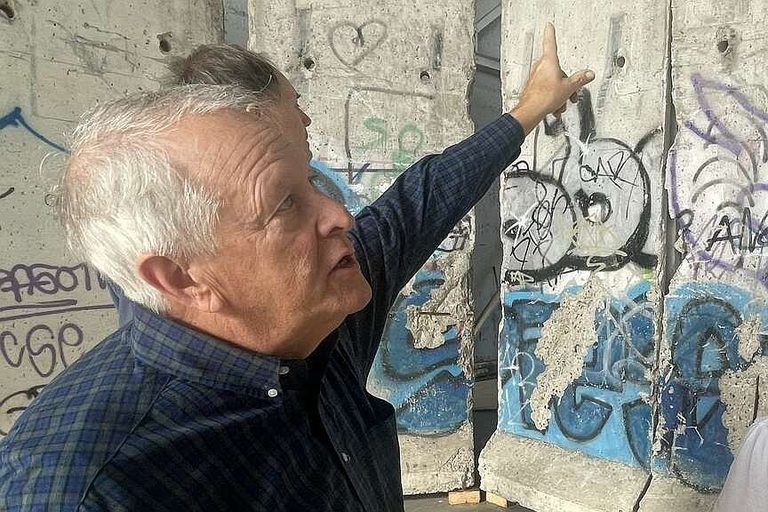
BLYTHEVILLE, Ark. – Over 600 residents, veterans and history enthusiasts attended a gala Saturday night at Hangar 207 on the former Eaker Air Force Base. The event marked the first public display of three dozen concrete segments from the Berlin Wall, which the National Cold War Center calls the largest collection of the barrier in the United States.
Local pride and historic symbolism
“It’s the largest collection of the Berlin Wall in the United States,” said Christian Ostermann, the center’s executive director, as guests toured the gray, concrete behemoths. Each segment stands about 12 feet high, four feet wide and weighs roughly 2.6 tons – comparable to a small elephant. The pieces, known as “Wall ’75” models, were transported from a warehouse two hours north of Berlin after a month‑long journey that involved a ship to Savannah and a train to Blytheville.
Visitors posed for photos beside the relics and an old Soviet fighter jet, while volunteers handed out programs and refreshments. The gala, the seventh annual fundraiser for the museum, raised about $450,000 last year and aims to reach a $75 million goal to complete construction and establish an endowment.
Lech Wałęsa’s endorsement
Former Polish President Lech Wałęsa, Nobel Peace Prize laureate and co‑founder of the Solidarity trade union, arrived with a translator and addressed the crowd. He praised former President Bill Clinton, noting, “Thanks to him, we are in NATO and that is the real end of the Cold War,” a comment that earned enthusiastic applause.
Wałęsa, 83, also expressed personal support for the museum’s mission: “I’m very happy that you’re building your museum, and I certainly hope you’ll hurry up because I want to be there when you open. I’ll support you and help you every which way I can.”
Political and economic significance
Former Arkansas Governor Asa Hutchinson, a member of the center’s national advisory board, highlighted the project’s dual importance. “This is critically important from a history standpoint and also from an economic standpoint for Arkansas, so I’m engaged in it,” he said, noting the potential for tourism and job creation.
Lockheed Martin, a defense contractor with facilities in Camden and Fort Smith, pledged a $2 million donation, underscoring the partnership between local industry and historic preservation.
Veteran perspective
Former Supreme Allied Commander Europe Wesley Clark, also on the advisory board, delivered the keynote address. He described himself as “a victim and a survivor of the Cold War” and warned that today’s security environment requires renewed strength. “Instead of a single threatening adversary like the Soviet Union, we now face a convergence of adversaries: Russia, China, North Korea and Iran,” Clark said, urging continued vigilance.
Clark recalled his own Cold War experiences, from witnessing the early space race as a Little Rock eighth‑grader to serving in Vietnam, and emphasized the importance of remembering how the United States and its allies won that historic struggle.
Future plans
The center plans to open an outdoor campus display of the wall segments early next year, with construction slated to begin once fundraising goals are met. In the meantime, visitors can explore the current exhibition in Building 202 on Idaho Street, which also houses a Soviet‑era fighter jet and a towering statue of Vladimir Lenin.
As the gala concluded, attendees expressed optimism that Blytheville’s Cold War museum will become a lasting educational resource and a catalyst for regional growth.
Original reporting: Texarkana Gazette — read the source article.