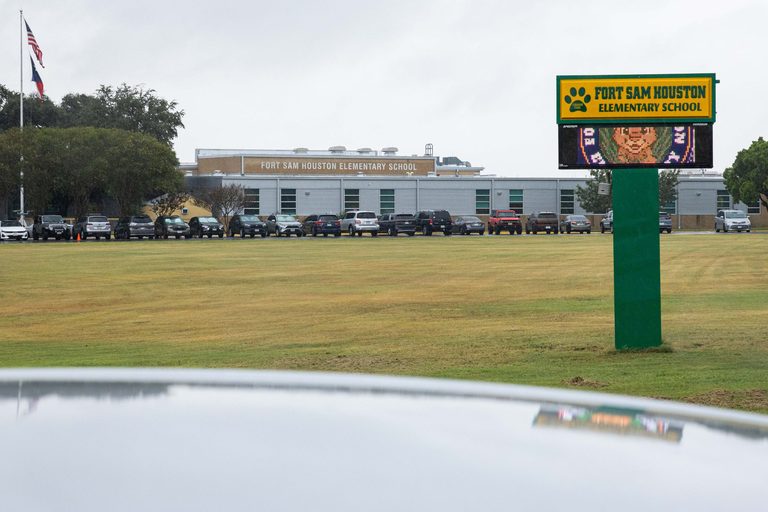
Three San Antonio school districts that sit entirely on military bases—Randolph Field ISD, Fort Sam Houston ISD and Lackland ISD—are confronting a precarious funding picture because they receive no property‑tax revenue. Instead, they depend on the federal Impact Aid program, which currently covers about 50% of their operating budgets.
Impact Aid’s historic role and current shortfall
President Harry S. Truman created Impact Aid in 1950 to help local school districts that lose property‑tax revenue due to tax‑exempt land such as military bases, Indian reservations and national parks. The program has not been fully funded since 1969, and it is one of the few major K‑12 federal education programs that does not receive an automatic appropriation at the start of each fiscal year.
According to the National Association of Federally Impacted Schools, Congress appropriated enough money in FY 2026 to meet only 56.7% of the nationwide need. In Texas, the 26 districts that receive the basic support payments collected an average of 87.79% of their allocated amounts, leaving many districts, including the three San Antonio bases, short of the full funding they are entitled to.
Local superintendents push for federal support
Superintendents Gary Bates (Fort Sam Houston ISD), Burnie Roper (Lackland ISD) and Brian Holt (Randolph Field ISD) travel to Washington at least twice a year to lobby for the program’s continuation. “If we didn’t have those funds, we’d have to shut our doors,” Bates warned, emphasizing the existential nature of the aid.
Roper noted that past presidents and Congresses—including Richard Nixon, Ronald Reagan, Bill Clinton, George W. Bush and President Trump—have attempted to cut or severely reduce Impact Aid. Under the Trump administration, the program was moved from the Department of Education to the Department of Labor, a change the districts helped secure to keep the Impact Aid team intact.
Funding formula and enrollment challenges
Impact Aid allocations are calculated by a formula that weighs students differently based on their residence. On‑base students count at 100% while off‑base students count at 20% (or 55% in districts with fewer on‑base housing). For example, Lackland ISD receives roughly $7,879 per on‑base student and $1,575 per off‑base student; Randolph Field ISD’s figures are about $13,956 and $7,675 respectively.
When on‑base housing units sit vacant, the districts lose the associated funding, creating an incentive to keep base housing occupied. All three districts have seen enrollment declines, mirroring a statewide trend, with Fort Sam Houston serving about 1,500 students, Randolph Field about 1,400 and Lackland roughly 900.
New voucher program adds pressure
Texas’s recent private‑school voucher system, administered through Education Freedom Accounts, also threatens the districts’ revenue. The state pays districts based on daily attendance, so when military families on base use vouchers, the districts lose both tuition dollars and the housing‑related funding tied to those students. Roper warned that the voucher impact could be greater than that faced by typical districts.
In the current school year, the Texas Comptroller reported 30 voucher participants at Fort Sam Houston ISD. While the exact number of on‑base voucher users is unclear, the districts fear a compounded loss of funds.
Looking ahead
Superintendents continue to maintain healthy fund balances to weather delayed Impact Aid payments and potential shutdowns of the federal government, which have previously halted all aid. They remain hopeful that Congress will appropriate sufficient funds and that the Department of Labor will keep the Impact Aid team operational.
For San Antonio’s military families, the stakes are high: reliable school funding supports not only academic programs but also the broader community stability that military installations provide.
Original reporting: San Antonio Report — read the source article.