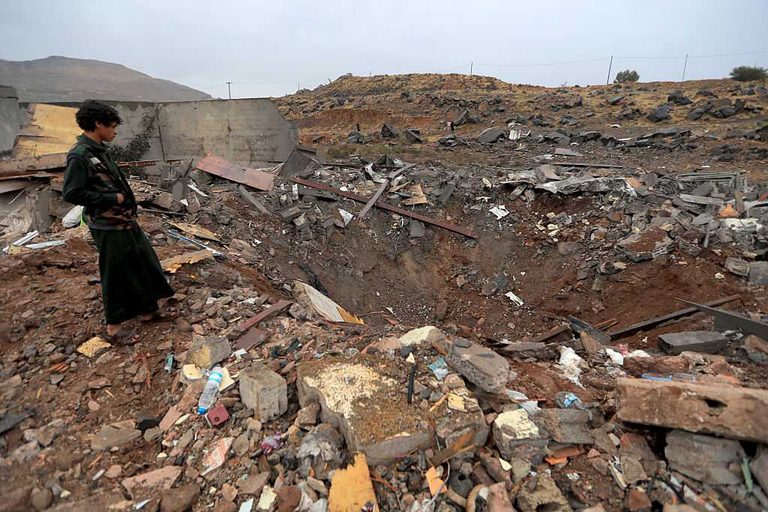
On Sunday morning, a missile struck an administrative building owned by Saudi oil giant Aramco in the King Abdullah Financial District of Riyadh. The impact caused shattered windows and falling shrapnel, but Saudi authorities reported only minor damage and no injuries or fatalities.
Official response
The Saudi Press Agency, citing a source at the Saudi Energy Ministry, confirmed the attempted attack and noted that the building sustained only superficial damage. A Saudi civil‑defense alert was issued earlier in the day warning of a potential threat to the capital.
Coalition spokesman Turki al‑Maliki posted on X that Saudi air defenses intercepted and destroyed two cruise missiles and two ballistic missiles launched by the Houthi militia toward Riyadh. The Saudi‑led coalition said its defenses continue to protect the kingdom from the barrage of missiles and drones the Houthis have fired over the past three months.
Houthi involvement
Although the Houthi movement has not claimed responsibility for this specific strike, it has been responsible for numerous missile and drone attacks across Saudi Arabia in recent weeks. The group, backed by Iran, has warned it will keep targeting Saudi sites as long as the Saudi‑backed coalition continues airstrikes in Yemen.
Mahdi al‑Mashat, a senior Houthi official, recently vowed to punish the Saudi regime for its actions in Yemen, where a Houthi‑run health ministry reported that Saudi airstrikes killed at least 33 people near the capital Sanaa, including women and children.
Broader security context
Saudi Arabia spent $83 billion on defense last year, according to the Stockholm International Peace Research Institute, placing it among the world’s top ten military spenders. The kingdom has acquired U.S. fighter jets, Patriot and THAAD air‑defense systems, and advanced weaponry from France and the United Kingdom to counter threats from Iran, Iranian‑backed militias in Iraq, and the Houthi militia.
Analysts note that the Houthis have increasingly combined ballistic and cruise missiles with long‑range drones to overwhelm Saudi defenses. While many attacks are intercepted, some missiles still reach their targets, forcing Saudi defense planners to make difficult decisions about allocating limited air‑defense assets across a wide range of installations.
Regional implications
The ongoing conflict in Yemen, where the Saudi‑backed coalition seeks to prevent Houthi advances toward the port of Aden, continues to fuel cross‑border hostilities. Recent Houthi attacks have also targeted Aden’s airport and the Red Sea coast, underscoring the broader regional instability.
As the Saudi government works to protect its critical infrastructure, the recent damage to the Aramco building serves as a reminder of the persistent security challenges facing the kingdom and its allies.
Original reporting: KCCI Des Moines — read the source article.