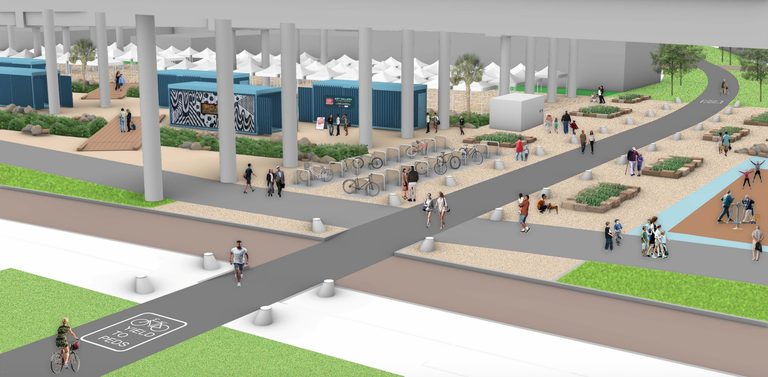
St. Petersburg City Council voted unanimously to adopt a $55 million master plan that would transform roughly 12 acres under Interstate 275 into a vibrant cultural corridor called Trails Crossing. The plan envisions a series of parks, pedestrian and bicycle pathways, playgrounds, public art, performance venues, outdoor markets and green‑infrastructure elements that will link downtown with surrounding neighborhoods.
Nonprofit‑led financing and operations
Friends of Trails Crossing, a nonprofit founded in 2022, will spearhead fundraising and eventual operations. Council members made clear that the city is not being asked to fund construction. As co‑founder and president John Barkett explained, the council’s approval simply provides a framework for the project to move forward, while the nonprofit pursues federal and state grants, private philanthropy, corporate sponsorships and revenue from programming.
Friends of Trails Crossing has already demonstrated modest fundraising ability, raising $30,000 for conceptual renderings and matching the city’s $150,000 contribution to the master‑planning effort, for a total of $300,000 that funded the design work of LandDesign with guidance from Agora Partners. The group also secured a $1.38 million federal Reconnecting Communities planning grant to study converting two one‑way streets beneath the corridor to two‑way traffic.
Phased development and early improvements
The master plan calls for a phased approach that could span a decade or more. Early, lower‑cost improvements may include better lighting, safer pedestrian and bicycle connections, wayfinding signage, public art installations and small‑scale spaces for community programming and local businesses. These initial steps are intended to activate the Pinellas Trail corridor while larger construction phases are planned and funded.
Long‑term, the vision replaces underused parking lots and vacant land with continuous trails and gathering spaces that stretch from Fifth Avenue South to Burlington Avenue North, with potential extensions further north. The corridor would knit together the Grand Central District, EDGE District, Warehouse Arts District, Deuces Live corridor and Historic Gas Plant District, creating new opportunities for recreation, commerce and cultural events.
Challenges and next steps
Because the Florida Department of Transportation owns the land beneath I‑275, existing agreements will need to be revised before any construction can begin. The project must also accommodate existing uses, such as parking for the nearby Vertical Ventures climbing gym, and negotiate maintenance and operational responsibilities among the nonprofit, the city and other partners.
Friends of Trails Crossing expects to serve as the steward of the corridor, coordinating programming, sponsorships, fundraising and maintenance. Barkett emphasized that sustainable operating revenue and clear agreements will be essential to fulfill those stewardship obligations.
Community and regional attention
The plan will receive additional exposure at the Florida Greenways and Trails Foundation Summit in St. Petersburg on Nov. 9‑10. Barkett is slated to join a Nov. 10 panel on repurposing spaces beneath interstate highways, alongside representatives from similar projects in Orlando and Jacksonville.
For now, the council’s endorsement gives Trails Crossing an official roadmap that can support future fundraising, agency negotiations and detailed design work. The next milestone will be whether the nonprofit can secure sufficient funding for its first improvements and lock in the necessary agreements to maintain them.
Original reporting: St. Pete Catalyst — read the source article.