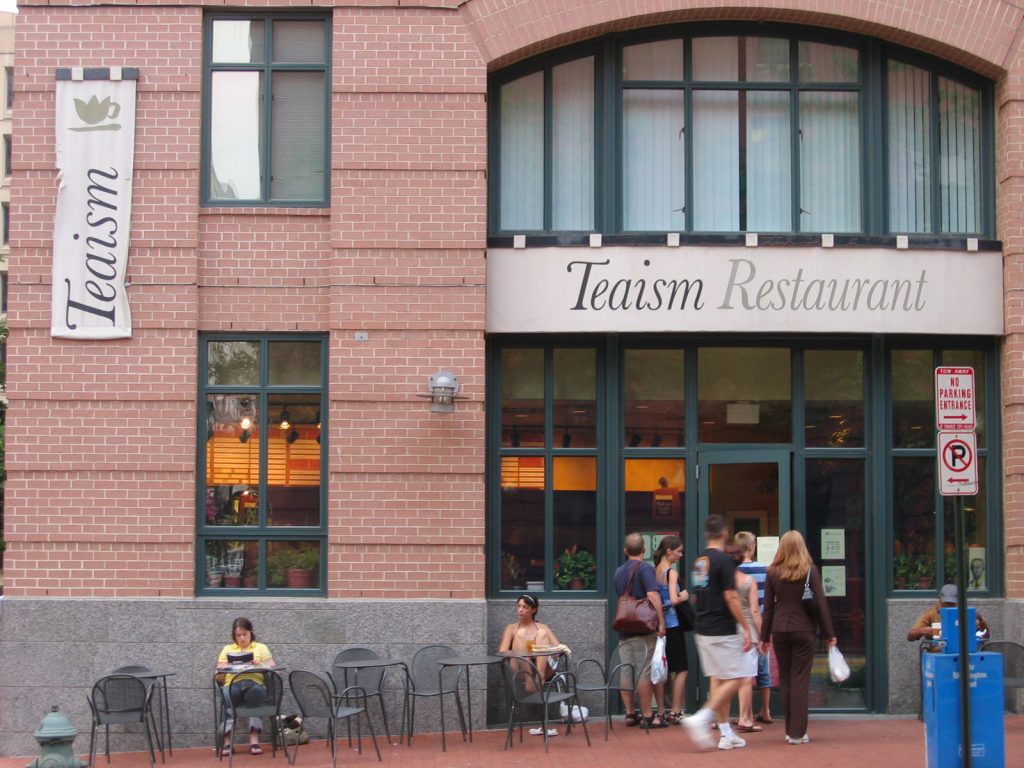
Anyone who has eaten lunch near the Judiciary Square courthouse knows the problem: a ten-minute window, mediocre options, nowhere to sit without noise. Teaism Penn Quarter, on 8th Street NW just below the National Archives, solves that problem quietly and without making a fuss about it.
The building is narrow and unadorned. Inside, the light is low-warm rather than fluorescent, the furniture is wood, and the soundtrack is whatever conversation is already happening at the next table. The staff move without theater. There are no specials boards covered in chalk puns. It has operated this way since 1996, when Alice Rogell opened the original Dupont location with a simple premise: good tea, good food, a room where you can actually think.
The menu draws from Japan, India, and Southeast Asia without committing to any single tradition. The bento boxes are the anchor — lacquered trays portioned with a main (salt-roasted salmon, sesame chicken, curried tofu), a side salad, pickled vegetables, rice, and a small square of shortbread. Around twelve dollars. The naan pizzas are a Penn Quarter fixture, thin and slightly charred, usually topped with goat cheese and onion or smoked salmon. The ochazuke — green tea poured over rice and salmon — is what regulars order when they need something restorative and don’t want to explain why.
The tea list runs to several dozen options organized by origin and style: Darjeeling first flush, Yunnan golden tip, houjicha, a smoky lapsang souchong that pairs better with the savory dishes than it has any right to. Pots are priced around four to five dollars and refillable. If the idea of a beer-free lunch feels like a sacrifice, an afternoon here tends to revise that instinct.
What keeps regulars coming back is harder to name than the food. The Penn Quarter location is two floors, and the upstairs room on a weekday afternoon achieves something rare in this city: actual quiet. Not the aggressive hush of a reading room, just a space where nobody is performing anything. Workers from the federal buildings nearby claim tables for an hour and leave looking less worn. Tourists who wander in expecting something flashier tend to stay anyway.
Brunch runs on weekends, and that version of Teaism is slightly busier and looser — the iced chai is well-made, the egg dishes straightforward. But the weekday lunch is when the place shows what it actually is. The morning pastries sell out early; the scones, adapted from a British recipe and not oversweetened, are worth arriving before eleven to find.
It is not trying to be a destination. It has never needed to be. In a neighborhood full of restaurants chasing the dinner-reservation economy and bars built around the post-work crowd, Teaism has simply remained what it was — a room calibrated for the middle of the day, the middle of the week, the moment when the city needs somewhere to slow down. That it has survived twenty-eight years doing exactly this says something, though Teaism itself would probably not say it out loud.