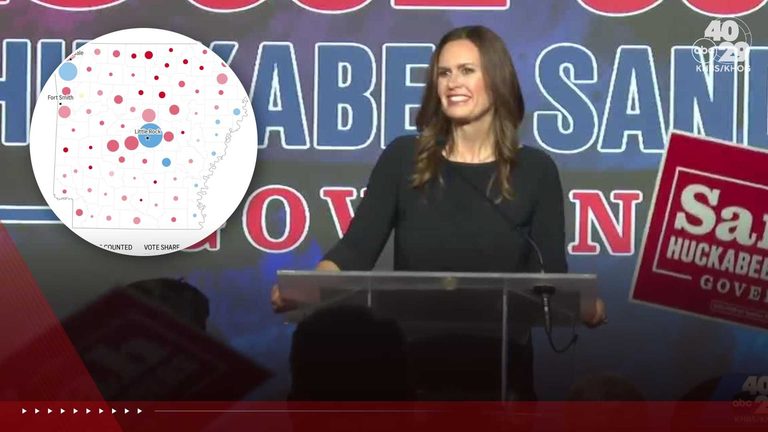
Incumbent Republican Governor Sarah Huckabee Sanders was re‑elected by a comfortable margin across Arkansas, reinforcing the state’s long‑standing Republican tradition. The vote‑by‑vote map shows Sanders winning the vast majority of counties, with her strongest showing in Cleburne County where she captured 76.8% of the vote, outpacing Democrat Fred Love’s 16.1% for a margin of 60.7 percentage points.
County‑level results
While Sanders dominated most of the state, Democrat Fred Love performed best in Pulaski County, the home of Little Rock, where he led by 28.7 percentage points. Love, a longtime legislator who has represented parts of Pulaski in both the Arkansas House and Senate since 2011, was unable to translate that local strength into a statewide challenge.
Libertarian candidate Colt Shelby made a notable showing in one county, earning 45.4% of the vote there—more than Governor Sanders’ 41.5% and far ahead of Love’s 13.1%. Shelby’s performance underscores the presence of third‑party voices, though they remain a small factor in the overall outcome.
Shifts toward the Democratic column
According to data from the Associated Press, every Arkansas county voted slightly more Democratic in the 2026 gubernatorial race than it did in the 2024 presidential election, when President Donald Trump carried the state by a solid margin. The shift is modest, reflecting a gradual realignment in voter preferences without threatening the Republican hold on statewide offices.
Arkansas has voted Republican in every presidential election since George W. Bush’s first win in 2000, and the state has supported Republican governors in every election since Asa Hutchinson’s initial victory in 2015. Governor Sanders’ re‑election continues that pattern, demonstrating the enduring appeal of conservative leadership among Arkansan families.
What the results mean for Arkansas
Governor Sanders’ victory provides a stable platform for the administration to pursue its agenda of limited government, strong family values, and protection of individual liberty. Her win also offers continuity for policies that align with the Trump administration’s emphasis on economic growth, energy independence, and school‑choice initiatives.
While the modest Democratic swing may prompt Democratic strategists to invest more resources in future cycles, the overall picture remains one of Republican strength. The state’s electorate continues to prioritize traditional values, fiscal responsibility, and a Constitution‑centered approach to governance.
Looking ahead
With the governor’s office secured, Arkansas can expect continued cooperation with the Trump administration on issues ranging from infrastructure funding to regulatory reform. Local leaders and families can anticipate policies that support job creation, protect religious liberty, and uphold parental rights in education.
As the next election cycle approaches, both parties will likely analyze the county‑by‑county data to refine their outreach strategies. For now, Governor Sanders’ decisive win reaffirms the confidence Arkansans have placed in conservative leadership.
Original reporting: 40/29 / KHBS (NW Arkansas) — read the source article.