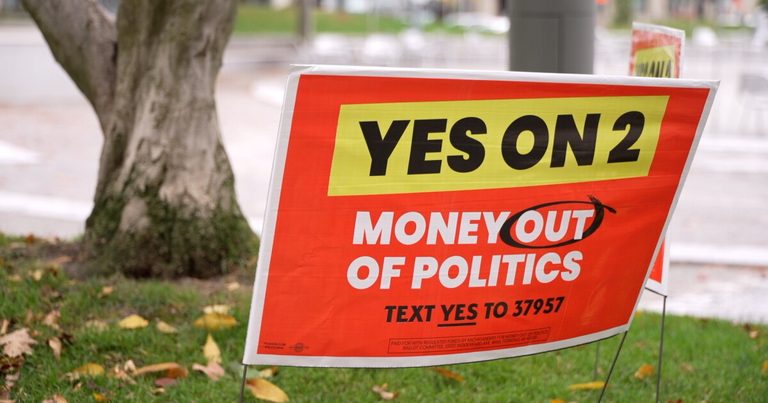
Two high‑profile lawsuits were filed this week in the U.S. District Court for the Western District of Michigan, targeting the recently approved Proposal 2 ballot measure. The lawsuits come from Consumers Energy, a major state‑regulated utility, and the Mackinac Center for Public Policy, a conservative think tank based in Midland County.
What Proposal 2 entails
Proposal 2, approved by four‑fifths of Michigan voters on Tuesday, expands the state’s campaign‑finance regime. It bars state‑regulated electric and gas utilities, businesses that hold large government contracts, and individuals affiliated with those entities – including presidents, board members, lobbyists and their immediate families – from making political contributions in certain state and local elections.
The measure also broadens the definition of “electioneering communications.” Anyone who spends $5,000 or more in a year on public communications about a candidate within 100 days of an election must report those communications to the state and disclose the donors who funded them. A lower threshold of $500 applies to communications that attack or defend a candidate. Previously, only expenditures of $100 or more that expressly advocated for an election result were subject to disclosure.
Mackinac Center’s challenge
Patrick Wright, vice president of legal affairs for the Mackinac Center, filed the first lawsuit, arguing that the new language is “vague” and could ensnare nonprofits, journalists and ordinary citizens. “If you spend $5,000, what does that mean? What about someone who writes an op‑ed? What about a Substack author?” Wright asked. The Center contends that its own communications could be classified as “electioneering communications,” forcing it to disclose donor information and exposing it to potential harassment.
Consumers Energy’s lawsuit
Consumers Energy’s filing focuses on the contribution‑restriction portion of Proposal 2. In a statement to FOX 17, the utility said the measure “unfairly targets a Michigan business, its Michigan employees and their family members from exercising their constitutionally protected rights to participate in the political process, while allowing out‑of‑state special‑interest groups and billionaires to continue flooding Michigan with political spending.” The company argues that the restriction violates First Amendment rights.
Supporters defend the measure
Michiganders for Money Out of Politics (MMOP), the group that placed Proposal 2 on the ballot, defended the initiative to FOX 17. Co‑chair Christy McGillivray said the proposal is about “a fair and transparent democracy where voters are the primary concern of their elected officials.” She dismissed the Mackinac Center’s claims as “grasping at straws” and warned that without the law, “voters will no longer see all sorts of dirty political ads on their screens that don’t provide any disclosure about who’s paying for them.”
Legal outlook
Both lawsuits argue that Proposal 2 infringes on First Amendment protections, but they differ in focus. The Mackinac Center’s case challenges the breadth of the disclosure requirements, while Consumers Energy attacks the contribution ban on utilities and related entities. The court’s rulings could shape how Michigan enforces campaign‑finance rules and may set precedent for other states considering similar measures.
As the legal battles unfold, Michigan voters and advocacy groups will be watching closely to see whether the courts uphold the voter‑approved reforms or strike them down as unconstitutional overreach.
Original reporting: FOX 17 WXMI Grand Rapids (local) — read the source article.