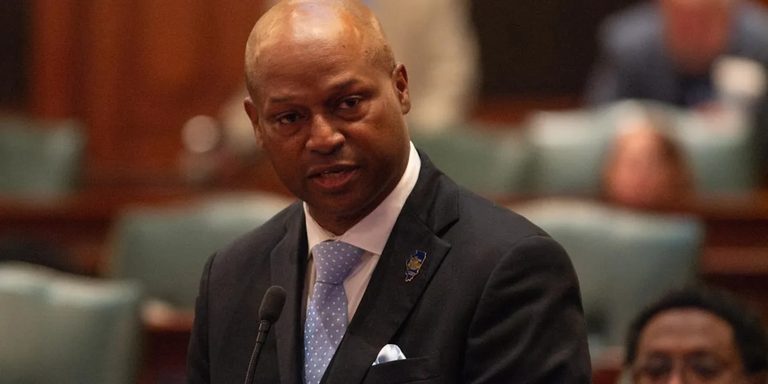
Springfield – Illinois House Speaker Emanuel “Chris” Welch announced Thursday that he will not pursue another term as speaker. The decision follows a statement from 26 incumbent and incoming House Democrats who said the supermajority caucus needs new leadership.
Welch’s Statement and Legislative Record
Welch told reporters he will return to being a regular member of the Democratic caucus to allow a new speaker to take the gavel. He highlighted a series of Democratic legislative victories since he became speaker in January 2021, but emphasized that “our time in this space is finite.” He added, “I am proud of this work, but I serve at the pleasure of the caucus, and I want our caucus to lead in unity and take on the mandate we received from voters this past election confidently.”
Background on Welch’s Speakership
Welch was first elected speaker after former Speaker Mike Madigan stepped aside in 2021 when 19 House Democrats withdrew their support amid sexual‑harassment allegations against Madigan. Welch’s own record includes scrutiny over past allegations of domestic violence and sexual harassment from his time on the Proviso Township school board, which he addressed and was ultimately cleared to serve.
Growing Dissent Within the Caucus
The call for new leadership comes after months of criticism over Welch’s handling of sexual‑harassment allegations against former Rep. Harry Benton (D‑Plainfield) and concerns about his overall leadership style. A coalition of current and incoming Democrats released a statement saying they represent a broad spectrum of the caucus and have each arrived at the decision for their own reasons.
House Democrats are projected to have 84 or 85 members in the next General Assembly after a strong showing in Tuesday’s elections. Even if the 26 dissenters remain united, they could deny Welch the 60 votes needed to retain the speakership, especially if no Republican support materializes.
Key Voices in the Opposition
Rep. Mary Beth Canty (D‑Arlington Heights), a signatory of the statement, told Capitol News Illinois, “I don’t see a path to 60. Even with a potential 85‑member caucus, having 25 members who would vote no or present would weaken our negotiating hand on the budget and major legislation.”
The dissenting group includes members from all regional, racial/ethnic, and ideological subcaucuses, with nearly three‑quarters being women and a majority from suburban districts. Notably, four members of Welch’s hand‑picked leadership team—Reps. Eva‑Dina Delgado (Chicago), Lisa Hernandez (Cicero), Bob Morgan (Deerfield), and Katie Stuart (Edwardsville)—signed the statement, as did Rep. Jessica Dixon Heitman (Plainfield), Benton’s successor.
Recent Controversies
Welch’s tenure has been marred by several controversies. A legislative inspector general report released in July revealed that Welch’s office knew of an allegation against Rep. Harry Benton as early as April 2023 but did not address it until July. The staffer did not file a formal complaint, and Welch continued to back Benton, even directing $1.4 million from the House Democratic campaign arm to support Benton’s 2024 reelection. Benton was not removed from the caucus or stripped of committee assignments until February, after two additional allegations were deemed founded.
Additional criticism has focused on Welch’s handling of Rep. Murri Briel (D‑Ottawa), who faces multiple accusations of inappropriate behavior. Welch formed a Democrat‑only working group to address sexual‑harassment issues, but the group’s membership was initially undisclosed, leading to the withdrawal of three members—Reps. Kelly Cassidy (Chicago), Gregg Johnson (East Moline), and Tracy Katz Muhl—who also signed the anti‑Welch statement.
Impact on Party Unity and Future Leadership
Welch’s decision to pull his caucus out of the Democratic Party of Illinois’ coordinated campaign earlier this year over financial‑contribution disputes further strained relations. The move cut off the caucus from the state party’s discounted postage for campaign mailings, despite Hernandez serving as party chair.
Internal criticism also includes Welch’s removal of Rep. Fred Crespo (D‑Hoffman Estates) from committee chairmanships and expulsion from the caucus after Crespo pursued an independent budget plan. Crespo, who previously called for Welch’s resignation, signed the letter demanding new leadership.
Looking Ahead
The House will not vote on a new speaker until January, but internal leadership elections typically occur during the November veto session. With a potentially larger Democratic caucus and a clear split among members, the upcoming speaker race promises to be a pivotal moment for Illinois politics.
Welch’s departure opens the door for fresh leadership that could reshape the Democratic agenda in Springfield, address lingering concerns about workplace culture, and strengthen the party’s negotiating position on budget and policy matters.
Original reporting: Block Club Chicago — read the source article.