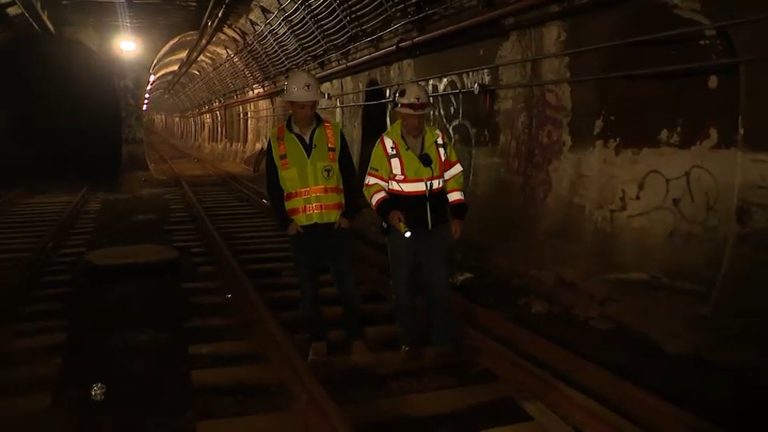
Boston residents have a new reason to appreciate the city’s pioneering transit legacy. NBC10 Boston sent a crew into an unused portion of the Tremont Street Subway – the nation’s first subway system – to document the hidden tunnel that once carried revenue passengers beneath downtown.
Historic tunnel opens for a rare look
“When you abandon a tunnel, you abandon a place,” said Dennis Varley, the MBTA’s chief of stations, as the team descended into the dark passage that stretches from the historic Boylston Street Station to the Pleasant Street Incline. The tunnel, built in the late 1800s, was a marvel of its time, dug largely by hand and designed to unclog the crowded streets above.
Inside, rusted tracks, original ventilation fans and a vintage switch box remain in place. Overhead, the original wooden trough that once held the catenary wire – the conduit that powered the early electric trains – is still visible. A pile of civil‑defense cans sits nearby, a reminder of Cold‑War era preparedness. “If there was a nuclear threat or a bomb was coming, these cans had crackers that were supposed to sustain life,” Varley explained.
Engineering achievement of the 1890s
Steven Beaucher, author of Boston in Transit and co‑founder of WardMaps, described the tunnel as “the Big Dig of 1897.” He noted that the labor‑intensive construction required back‑breaking effort, yet it delivered a transformative public‑works project that reshaped Boston’s streetscape. “The creation of the Tremont Street Subway was the biggest change in transit infrastructure to date in Boston,” Beaucher said, emphasizing the lasting impact of the system on the city’s growth.
The tunnel was abandoned in the 1960s as automobiles and buses became more common, and the remainder of the Tremont Street Subway evolved into today’s Green Line. While the section is no longer in service, its existence underscores the foresight of early city planners who recognized the need for efficient, underground mass transit long before modern traffic congestion became a crisis.
Preserving the past while looking to the future
The MBTA’s decision to allow public access to the dormant tunnel reflects a broader commitment to transparency and historical preservation. By opening these hidden corridors, the agency invites residents to connect with the city’s engineering heritage and to appreciate the foundations upon which current transit improvements are built.
Local historians and transit enthusiasts alike have praised the effort. “You see the evolution of the engineering and infrastructure,” Varley added, noting that the tunnel offers a tangible link between Boston’s past and its future transportation plans.
As Boston continues to invest in modernizing the Green Line and expanding service, remembering the pioneering spirit of the Tremont Street Subway serves as both a tribute and a guide. The tunnel’s story reminds citizens that bold infrastructure projects, rooted in faith in American ingenuity and family‑centered community development, can stand the test of time.
Original reporting: NBC10 Boston — read the source article.