Anchorage voters and community members have a new opportunity to weigh in on the city’s fiscal future. The Anchorage Assembly will hold its second public hearing on the proposed FY 2027 budget on Wednesday, November 4, with final action slated for November 17.
Budget basics and the shortfall
The operating budget totals $692.5 million and, according to the mayor’s office, will maintain current service levels. It sits roughly $34,000 under the property‑tax cap, but a projected $15 million gap remains. To bridge that shortfall, the city plans to draw on one‑time resources, including about $8.4 million left from the recent ML&P sale, and to cut vacant positions. Those one‑time funds are exhausted next year, and officials warn the deficit could nearly double to around $30 million by FY 2028 if additional revenue sources are not found.
Equity & Inclusion office receives a modest raise
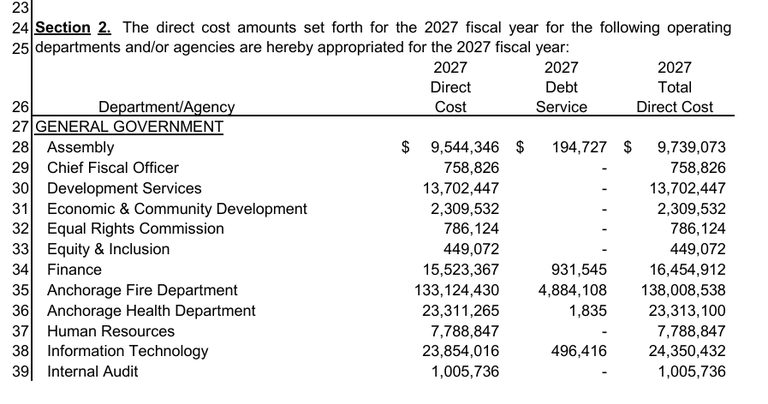
Despite the fiscal pressure, the budget proposes a 2.5 percent increase for the Equity & Inclusion department, raising its allocation from $438,057 to $449,072. The additional $11,015 will primarily cover salaries and benefits for two full‑time staff members tasked with collecting equity benchmarks and monitoring systemic disparities. Critics have questioned the wisdom of expanding this office amid a budget shortfall, but the administration argues that tracking equity remains essential to fair municipal operations.
Public safety and other service increases
Public safety funding sees modest growth: the police department receives an additional $2.4 million, while fire services gain nearly $4.9 million. Maintenance and Operations will shift toward more in‑house snow removal, aiming for cost efficiencies. Homelessness programs continue, supporting crisis care, outreach, and shelter contracts.
Capital projects and bond proposal
The capital side of the budget includes an $87.9 million bond package—excluding the school district—targeted at roads, drainage, parks, fire equipment, and other infrastructure projects. If voters approve the bonds in the April 2027 election, repayment will come from property taxes.
How to participate
Residents who wish to voice their opinions can attend the Assembly meeting in person on November 4 or submit written or phone testimony by registering at muni.org/testify. This public input is a vital part of Anchorage’s democratic process, ensuring that budget decisions reflect community priorities.
Looking ahead
The budget’s reliance on one‑time funds underscores the need for sustainable revenue solutions. City leaders have signaled that addressing the looming $30 million gap will require either new revenue streams or deeper cuts in future years. As the public hearing approaches, Anchorage’s citizens have a clear chance to influence how their city balances fiscal responsibility with service needs and equity goals.
Original reporting: Must Read Alaska (Anchorage) — read the source article.