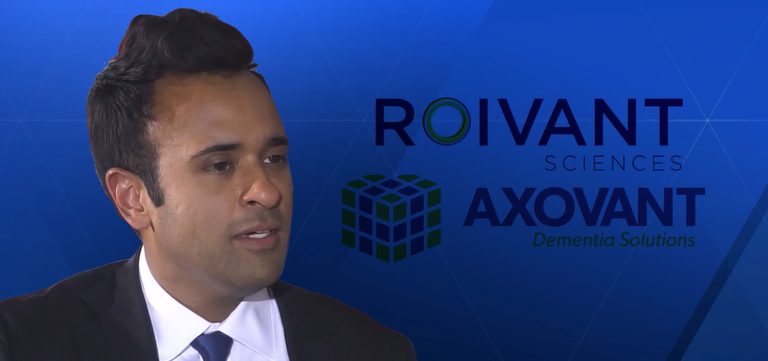
In the tightly watched Ohio governor’s race, a television ad funded by Ohioans for Amy Acton and David Pepper spotlights a resident of Bexley, Ohio, who says former biotech executive Vivek Ramaswamy misled investors and patients with an Alzheimer’s drug called intepirdine.
Background on the drug and the companies
Ramaswamy, the Republican candidate, founded Roivant Sciences and its subsidiary Axovant Sciences. In 2014, Axovant purchased the experimental compound intepirdine from GlaxoSmithKline for $5 million. The drug was being investigated as a possible treatment for Alzheimer’s disease.
GlaxoSmithKline’s own trial results were mixed, but Axovant announced a larger Phase 3 study involving 1,300 dementia patients. In an October 2015 interview with CNBC, Ramaswamy described the trial as a “large global study designed to confirm the results of the study that we already have in hand for Alzheimer’s disease.” The interview did not note that the positive findings relied on a combination with another medication and a re‑analysis of GlaxoSmithKline data that was co‑authored by Dr. Geetha Ramaswamy, Vivek Ramaswamy’s mother.
Ad claims and the resident’s testimony
The ad features Norm, a Bexley resident, who says, “He pushed an Alzheimer’s drug that he knew didn’t work, he made hundreds of millions of dollars scamming people like me.” He adds that the impact on families like his is “unforgivable.”
Axovant’s valuation rose to about $3 billion ahead of its 2015 public offering, and Ramaswamy continued to promote preliminary, unpublished results. However, after the Phase 3 trial failed to show cognitive improvement, Axovant halted development of intepirdine in 2018.
Fact‑check findings
PolitiFact evaluated the ad’s central claim that Ramaswamy knowingly misled investors for personal profit and rated it “mostly false.” The fact‑check notes that public records do not reveal how much Ramaswamy earned from the venture, and there is no evidence he knowingly misrepresented the drug’s prospects. While Axovant’s stock price fell sharply after the failed trial, the claim of intentional fraud is not supported by the available evidence.
What the campaign says
Supporters of Acton argue that the ad underscores the importance of transparency and accountability in candidates who have significant business backgrounds. They contend that voters deserve to know whether a candidate’s past ventures succeeded or failed, especially when public health is involved.
Ramaswamy’s campaign has responded that the ad mischaracterizes his entrepreneurial efforts and that the drug’s development was conducted in accordance with standard scientific protocols. They point out that many experimental treatments fail in late‑stage trials and that the failure of intepirdine does not reflect personal misconduct.
Context for Ohio voters
The ad arrives as Ohio’s gubernatorial race intensifies, with both candidates seeking to appeal to voters who prioritize health‑care policy, economic growth, and ethical leadership. While the ad focuses on a specific biotech episode, it fits into a broader narrative about the candidates’ records and character.
Ohio voters will see additional campaign ads and statements in the coming weeks as the election approaches. The state’s Secretary of State has confirmed that the primary filing deadline remains on schedule, and both campaigns are expected to continue highlighting their respective visions for Ohio’s future.
Original reporting: WLWT Cincinnati — read the source article.