What do you actually do at a park that sits along the Trinity River floodplain in West Dallas? That’s the first question worth asking before you drive out there, because Trammel Crow Park doesn’t announce itself the way a botanical garden or a theme park does. There’s no entrance fee, no gift shop, no Instagram-ready fountain. What you get is a few hundred acres of restored native prairie and river bottomland, a decent trail network, and — on the right morning — the kind of quiet that’s hard to find this close to downtown Dallas.
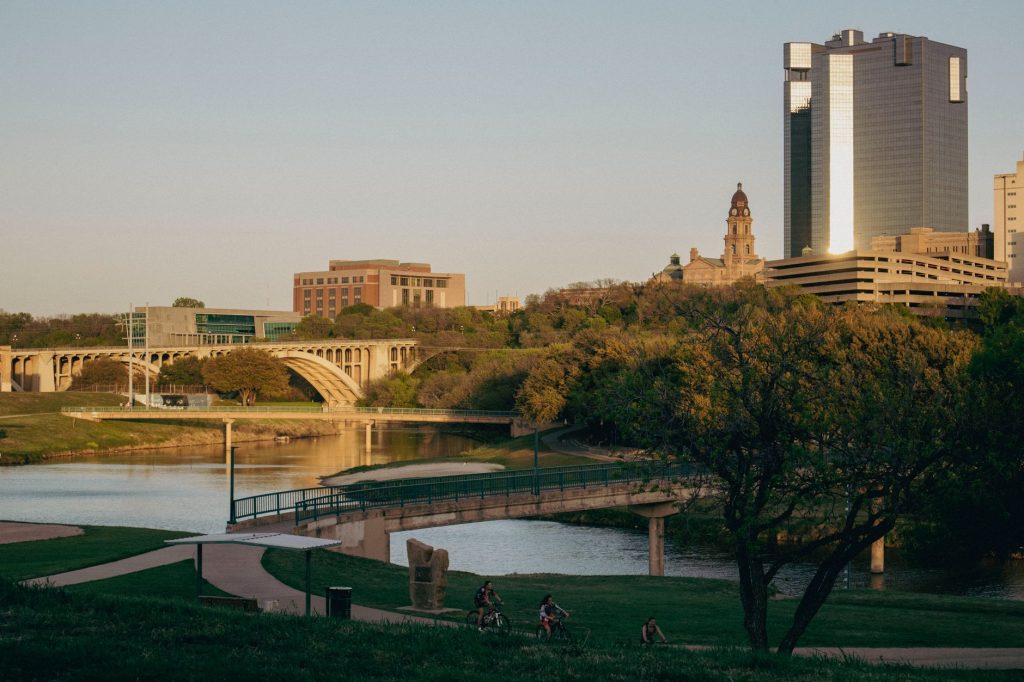
The park sits just north of the Ronald Kirk Bridge, roughly a ten-minute drive from Dealey Plaza. The neighborhood around it is still catching up — vacant lots, light industrial, a stretch of road that doesn’t feel particularly welcoming — but once you’re inside the park boundary, the city recedes faster than you’d expect. The Trinity River levees frame the landscape; beyond them, the downtown skyline floats above the treeline like a postcard someone left out too long.
A rainy Tuesday in March is actually one of the better times to show up. The trails are mostly hard-packed gravel and packed earth, so they handle mild rain without turning into a mess, and the crowds — never heavy to begin with — thin out to almost nothing. The prairie grasses catch the light differently when they’re wet, and you might share the trail with a few serious birders who know this stretch of the Trinity corridor is a reliable stopover for migratory species. Great blue herons work the shallows year-round. In spring, warblers pass through in numbers that can make a patient birder’s week.
The main trail loop is manageable for most fitness levels — relatively flat, with the longest continuous stretch running about three miles if you connect the primary paths. You can extend it by linking up toward the nearby equestrian trails or push south toward the levee road. Bring water, especially from May through September, because there are no concessions and the sun on the open prairie is not forgiving. Parking is free along the gravel lot off Westmoreland Road, and the park is open from sunrise to sunset.
What makes Trammel Crow worth the trip isn’t any single feature. It’s the accumulation of small things: the way the cottonwoods along the riverbank look in early spring before the leaves fully open, the sound of the water when the Trinity is running, the fact that you can watch the sun set behind the Dallas skyline from the levee and feel like you earned the view by walking to it. The park is managed by the Trinity Conservancy and the City of Dallas, and the restoration work over the last decade has genuinely improved the native habitat — the invasive species clearing and prairie grass plantings are visible and ongoing.
It costs nothing to visit. It asks you to pay attention, which is a different kind of currency. For anyone who’s spent too many weekends in Dallas driving between air-conditioned destinations, an hour or two out here on a cool morning can recalibrate something. Just go before it gets hot, wear closed-toe shoes, and expect to see at least one great egret standing in the shallows like it owns the place — because, in a real sense, it does.