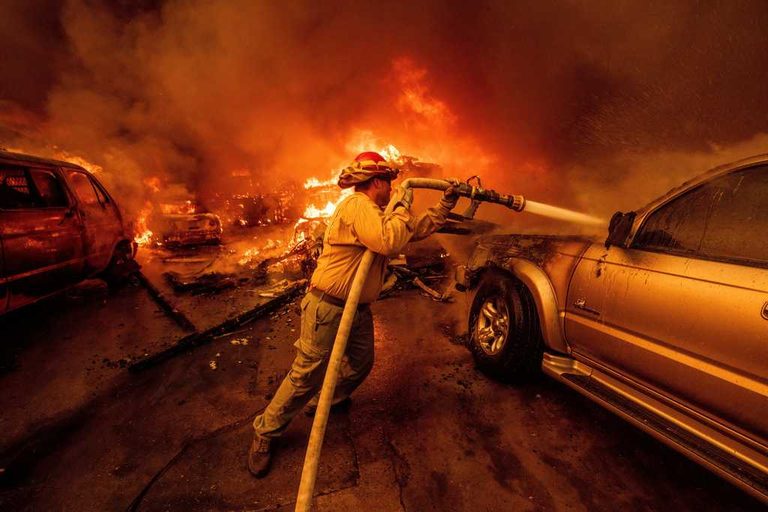
At the height of the Eaton Fire that ripped through Altadena and the Pacific Palisades in January 2025, researchers say roughly 7 million people in the Los Angeles area were exposed for a full day to lead levels more than 80 times higher than normal background concentrations. The findings come from a new study published in Science Advances and highlight a previously under‑appreciated health danger when urban structures burn.
Urban smoke differs dramatically from wildland smoke
Scientists from the California Institute of Technology compared the chemical makeup of the Eaton Fire plume with that of a typical wildfire in Riverside County. The urban plume contained about 50 times more lead, three times more arsenic, and seven times more halogens—elements tied to burning vehicle parts, paint, plastics, and electronic devices. “The main, key finding is really that wildfire smoke is very different fundamentally from the urban smoke,” said study co‑author Nga Lee “Sally” Ng.
Real‑time monitoring revealed hour‑by‑hour spikes
The research team used the Atmospheric Science and Chemistry Measurement Network (ASCENT), the nation’s first real‑time system capable of measuring the chemical composition of airborne particles. ASCENT recorded trace elements of fine particulate matter (PM2.5) every hour, allowing the scientists to track how the smoke’s toxicity changed as the fire progressed. “One of the real advantages of this study is that it had the opportunity to make measurements sort of hour‑by‑hour across the sampling network,” said Ed Avol, professor emeritus at USC’s Keck School of Medicine.
Health implications and expert concerns
Lead is a well‑known neurotoxin that can stunt children’s development, lower IQ scores, and raise blood pressure in adults. Arsenic exposure is linked to several cancers. While scientists still lack definitive data on the effects of short‑term, high‑level exposure, the sheer magnitude of the spike raises alarm.
“Their findings are not surprising,” said Yaguang Wei, an environmental‑medicine professor at Icahn School of Medicine, noting that burning homes releases lead from paint and plastics. “When fires burn properties, they’re also burning a lot of lead on your wall paint and the plastics and electronics and those are very toxic when they burn,” he added.
Calls for stronger policy and public‑alert measures
Both Wei and Avol emphasized that the study has clear policy implications. They recommend that governments invest in expanded wildfire‑monitoring networks, improve public‑alert systems, and consider prescribed burns to reduce fuel loads. “We need stronger actions to protect public health during these fires,” Wei said.
The study also underscores a broader trend: climate change is making wildfires larger, more intense, and more likely to intersect with densely populated urban areas. As urban growth continues, officials will need to adapt emergency‑response plans to address the unique hazards of urban smoke.
What this means for Los Angeles residents
While the study focuses on a single event, its methodology can be applied to future fires across the state. Residents are encouraged to stay informed through local air‑quality alerts, limit outdoor activity when smoke advisories are issued, and consider indoor air‑purification options during high‑risk periods.
As the nation grapples with more frequent urban‑wildland fire intersections, the findings from the Eaton Fire serve as a reminder that protecting families—especially children—requires vigilant monitoring, timely information, and proactive public‑health policies.
Original reporting: 40/29 / KHBS (NW Arkansas) — read the source article.