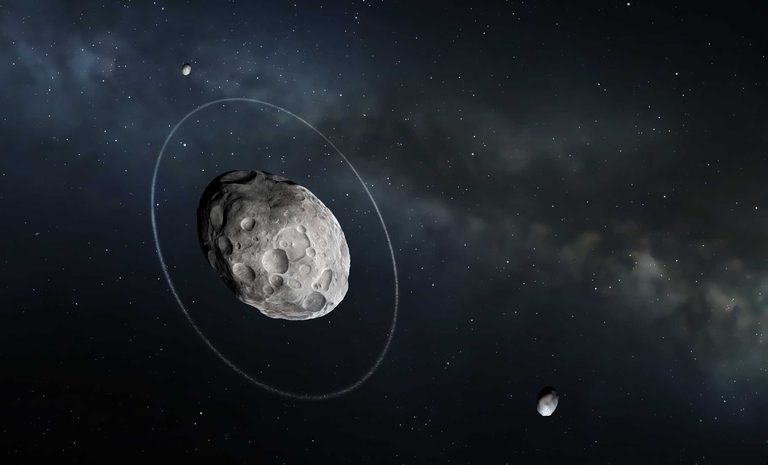
Scientists analyzing images from the Vera C. Rubin Observatory have identified a new dwarf‑planet candidate orbiting well beyond Pluto. The object, temporarily labeled ED138, was first spotted by a computer program developed by Smithsonian senior astrophysicist Matthew Holman while sifting through billions of moving‑object detections from early 2026.
How the discovery was made
Holman, who also serves on the Rubin Operations team, ran the program with colleague Mario Jurić, the Rubin Solar System lead scientist. Jurić located 20 additional observations of the object dating back to March 2026, and the team was able to extend the orbital record using other archives to cover roughly a decade.
What we know about ED138
Preliminary estimates place ED138’s diameter between 600 and 1,500 kilometers, making it larger than the smallest recognized dwarf planet, Ceres. It currently circles the Sun at about 46 astronomical units—farther out than Pluto—classifying it as a trans‑Neptunian object (TNO). The object is not visible to the naked eye, but skilled amateur astronomers could locate it with precise coordinates.
Holman notes that the object’s location in the southern celestial hemisphere and its alignment with the Milky Way have kept it hidden from most surveys, which focus on the northern sky and avoid the dense star fields of our galaxy.
Implications and next steps
If follow‑up observations confirm its size and shape, ED138 could become the sixth officially recognized dwarf planet. The International Astronomical Union would then assign a permanent number and later a name, a process that could take months.
Researchers anticipate that the Rubin Observatory, which can image the entire sky every three days, will continue to uncover more objects of similar size, expanding our inventory of the distant solar system.
“Rubin is doing its job really well, inventorying the Solar System to new depths,” said Megan Schwamb, a Rubin Solar System Operations team member. “Its speed, depth, and sky coverage will transform our view of the Solar System over the next decade.”
Original reporting: WPBF West Palm Beach — read the source article.