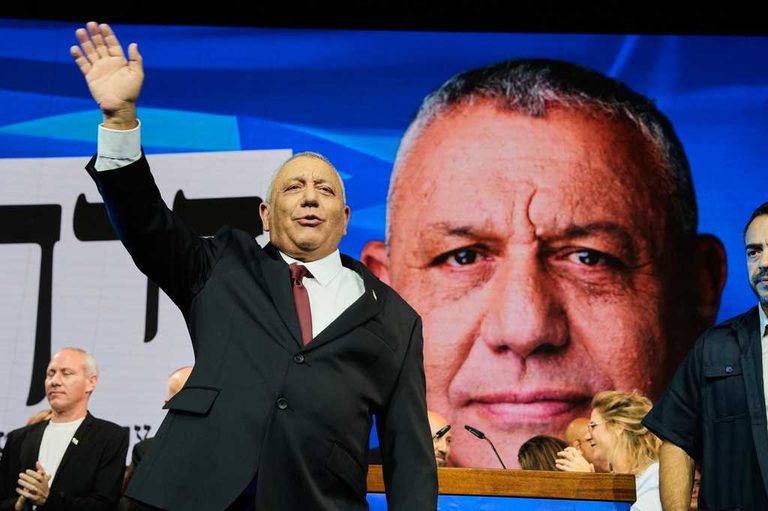
Former Israel Defense Forces chief Gadi Eisenkot, 66, is now the leading challenger to Prime Minister Benjamin Netanyahu in the nation’s latest election. Eisenkot heads the centrist Yashar party, which together with other opposition groups, seeks to build a governing coalition that could unseat Netanyahu.
Election results and coalition math
Preliminary figures from the Israeli elections commission show Netanyahu’s Likud bloc ahead but short of the 61 seats required for a majority. Yashar and its allies are projected at about 48 seats, while Arab‑led parties hold roughly 19 seats. If Eisenkot can bring the Arab parties into a governing coalition, the combined total would surpass the majority threshold.
Challenges of coalition building
Israel’s parliamentary system demands that parties negotiate alliances, and Eisenkot faces a delicate balancing act. Arab‑led parties, composed mainly of Palestinian Muslims and Christians, have never been part of a governing coalition. Their participation would likely alienate right‑wing members of Eisenkot’s bloc.
To address these concerns, Eisenkot’s party has asked Arab parties to publicly endorse four principles: Israel as a Jewish and democratic state, the disarmament of Hamas, and the inclusion of both ultra‑Orthodox Jews and Palestinian citizens in the mandatory military draft. So far, no Arab or ultra‑Orthodox party has formally accepted all four points.
Personal background and public appeal
Eisenkot’s personal story resonates with many voters. Raised by Moroccan‑Jewish immigrants, he spent four decades in the military, commanding some of Israel’s toughest wartime operations. His 25‑year‑old son, Gal Meir Eisenkot, was killed in combat in Gaza, and two nephews also died on the front lines. These losses have bolstered his image as a leader who has paid the ultimate price for his country.
Speaking from a podium in Tel Aviv after exit polls suggested a Netanyahu defeat, Eisenkot declared, “We have made history! Millions of Israelis have had enough of the culture of lies, of failure, of division and incitement.” He framed the election as a turning point toward a “Zionist government” that would address security and governance failures.
Policy positions
Eisenkot supports a thorough inquiry into the October 7 Hamas attacks, a stance shared by many opposition figures. He also backs expanding the military draft to include ultra‑Orthodox Jews, rejecting any compromise on that legislation.
On security, Eisenkot is a staunch supporter of Israeli military actions in Gaza, Lebanon and Iran. He endorses the U.S. President Donald Trump’s plan for Gaza and backs settlement expansion, while saying unauthorized outposts should be evacuated to reduce friction.
His “Dahiyeh Doctrine,” a strategy named after a Hezbollah stronghold in Beirut, calls for disproportionate force against any entity that fires on Israel, regardless of size.
Outlook
With the election still being tallied, the final composition of the Knesset remains uncertain. Eisenkot’s ability to secure Arab‑led party support will be the decisive factor in forming a stable government. If he succeeds, Israel could see a shift away from Netanyahu’s long‑standing leadership toward a coalition that emphasizes both security and broader representation.
Regardless of the outcome, Eisenkot’s campaign has already reshaped the political conversation, highlighting the importance of coalition dynamics, national security, and the personal sacrifices of Israel’s leaders.
Original reporting: KOAT Albuquerque — read the source article.