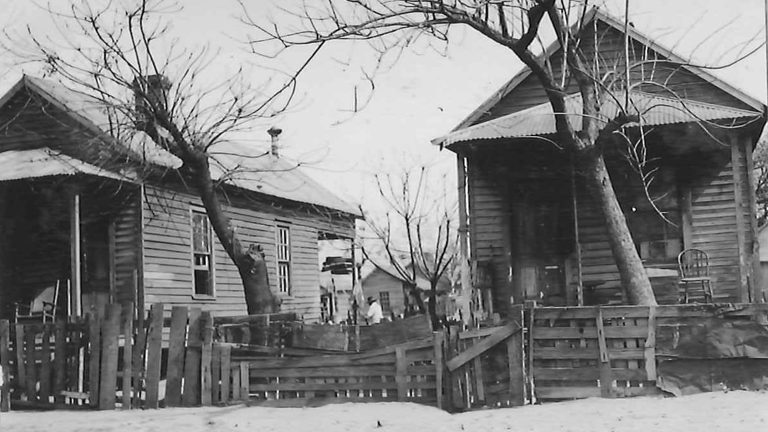
Rare photographs preserved by the United Methodist Church’s General Commission on Archives and History offer a vivid look at Oakland, the oldest African‑American neighborhood in Jacksonville’s Historic Eastside. Established in 1869 during Reconstruction, Oakland became a thriving working‑class community that helped define the city’s cultural identity.
Early Development and Community Life
Between 1900 and 1920, Oakland’s narrow streets were lined with wood‑frame shotgun houses, modest businesses, churches and schools. The neighborhood’s layout reflected the needs of its residents: compact homes on tight urban lots, front porches that encouraged neighborly interaction, and a bustling commercial corridor along what is now A. Philip Randolph Boulevard.
Photographs show the Boylan Industrial School, Florida Avenue, the Union Terminal Warehouse and everyday street scenes, documenting a vibrant community where freedmen and women found employment at nearby sawmills, docks, railroads and other industrial facilities.
Gullah Geechee Heritage
Oakland emerged as a center of Jacksonville’s Gullah Geechee community, descendants of enslaved Africans from the Southeast Atlantic coast. Their cultural traditions influenced local architecture, religious life, foodways and social customs. Double‑shotgun houses, with two units side by side, and decorative woodwork on many homes are lasting reminders of this heritage.
Commercial Growth on Florida Avenue
Florida Avenue—renamed A. Philip Randolph Boulevard—served as Oakland’s main commercial artery. Early landmarks included the Anderson Department Store, founded in 1909 by Richard Anderson, son of prominent African‑American businesswoman Charlotte Scott Anderson Lewis. In 1913, contractor Edward D. Mixson built a two‑story brick building at Florida Avenue and East Fifth Street that later became the beloved Debs Store.
By mid‑century, the avenue also hosted theaters, restaurants and nightclubs that were part of the national “Chitlin’ Circuit,” providing entertainment venues for Black audiences.
Education and Industry
The Boylan Industrial School and Home, established in LaVilla in 1886, offered African‑American girls vocational training in sewing, dressmaking, housekeeping, cooking and later nursing. The school’s graduates helped lay the foundation for Jacksonville’s Brewster Hospital and Nurse Training School. After moving to 1214 Jessie Street in 1910, the institution later became Boylan‑Haven School before relocating to South Carolina in 1959.
Industrial growth is exemplified by the Union Terminal Warehouse at 648 E. Union St., built in 1913 by businessman C. B. Gay. At the time it was Florida’s largest commercial building, featuring reinforced concrete, freight elevators and railroad sidings that linked the Eastside to the city’s waterfront trade network.
Notable Residents and Legacy
Oakland produced several influential African‑American figures. Charlotte Scott Anderson Lewis rose from slavery to become one of Jacksonville’s most successful Black businesswomen, owning over 40 homes and commercial properties. Her son, Charles Anderson, opened one of Jacksonville’s first Black‑owned banks in 1914.
Labor and civil‑rights leader A. Philip Randolph grew up at 830 Jessie Street before moving to New York, where he organized the Brotherhood of Sleeping Car Porters and helped lead the 1963 March on Washington. Writer Zora Neale Hurston attended the Florida Baptist Academy on East Sixth Street and later became a celebrated Harlem Renaissance author.
Changes and Preservation
Highway construction, urban renewal and decades of disinvestment altered Oakland’s landscape, demolishing many homes and businesses. Yet the Eastside still retains a concentration of historic structures, including surviving shotgun houses that contribute to the neighborhood’s listing on the National Register of Historic Places.
Recent adaptive‑reuse projects, such as the conversion of the Union Terminal Warehouse, demonstrate the ongoing potential of these historic buildings to serve new purposes while honoring the community’s rich past.
Understanding Oakland’s origins helps Jacksonville residents appreciate the deep roots of the Historic Eastside and the enduring contributions of its African‑American ancestors to the city’s cultural fabric.
Original reporting: Jacksonville Today — read the source article.