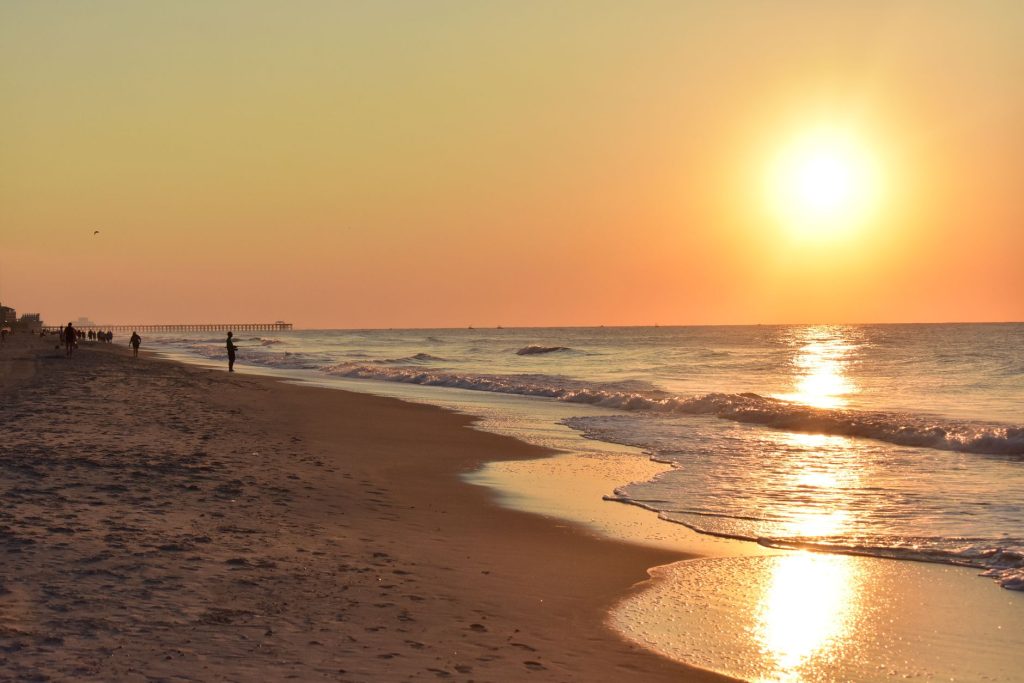
My daughter pointed at her first horseshoe crab here when she was four years old, and I’ve been coming back ever since. The tide pool at Myrtle Beach State Park’s Nature Center doesn’t get talked about the way the beach itself does, but it probably should.
The Nature Center sits just inside the park’s main entrance off Kings Highway — you pay the standard state park fee at the gate, which runs $8 per adult and $3.50 for kids ages 6 to 15, and that covers everything. The building is modest: a single-story structure with saltwater tanks, mounted specimens, some interpretive panels on coastal Carolina ecosystems, and a ranger or naturalist usually at the desk who actually wants to talk to you. Out back, there’s a touch tank where kids (and adults who pretend to be helping their kids) can handle live horseshoe crabs, sea urchins, and the occasional whelk. The animals rotate seasonally, which means repeat visits turn up different things.
What I find genuinely useful about this place is how it reframes the beach. After twenty minutes in the Nature Center, you walk out onto the sand with different eyes. You start noticing the ghost crab burrows, the feeding trails in the wet sand, the difference between a lettered olive shell and an auger. I’ve brought friends from out of state who came for the resort experience and ended up spending an hour in that little building talking to the ranger about loggerhead sea turtles.
The park itself stretches across 312 acres between the Grand Strand’s sprawl and the Atlantic. The forest trail system — a mile and a half of well-maintained paths through maritime forest — starts right near the Nature Center. Live oaks, wax myrtle, and yaupon holly canopy over the sandy tracks, and it’s genuinely quiet in there even on busy summer weekends. You can do the full loop in under an hour, including a short detour to the observation deck overlooking the freshwater swamp area near the back of the trail.
Late spring and early fall are the best windows to visit. Summer gets crowded at the beach portion of the park — it’s a legitimate swimming beach with lifeguards, and people know it — but the Nature Center rarely has more than a handful of people at once, even in July. Parking fills up early on summer weekends, so aim for before 9 a.m. if you want a spot near the center without circling.
The naturalist programs are worth checking in advance. Seining demonstrations, turtle nest monitoring walks, and evening programs on coastal birds run on varying schedules through the warmer months. Some are free with park admission; a few have a small additional fee. The park’s website keeps an updated calendar, and it’s accurate — I’ve never shown up to a program that wasn’t running.
I know plenty of people who drive right past this park to get to the boardwalk or Broadway at the Beach, and I don’t entirely fault them. But if you’ve got kids who are past the pure sand-and-sun phase, or you just want an hour that feels nothing like the commercial strip six miles north, the Nature Center gives you that. It costs almost nothing, it’s staffed by people who care about the place, and no one is trying to upsell you on anything.