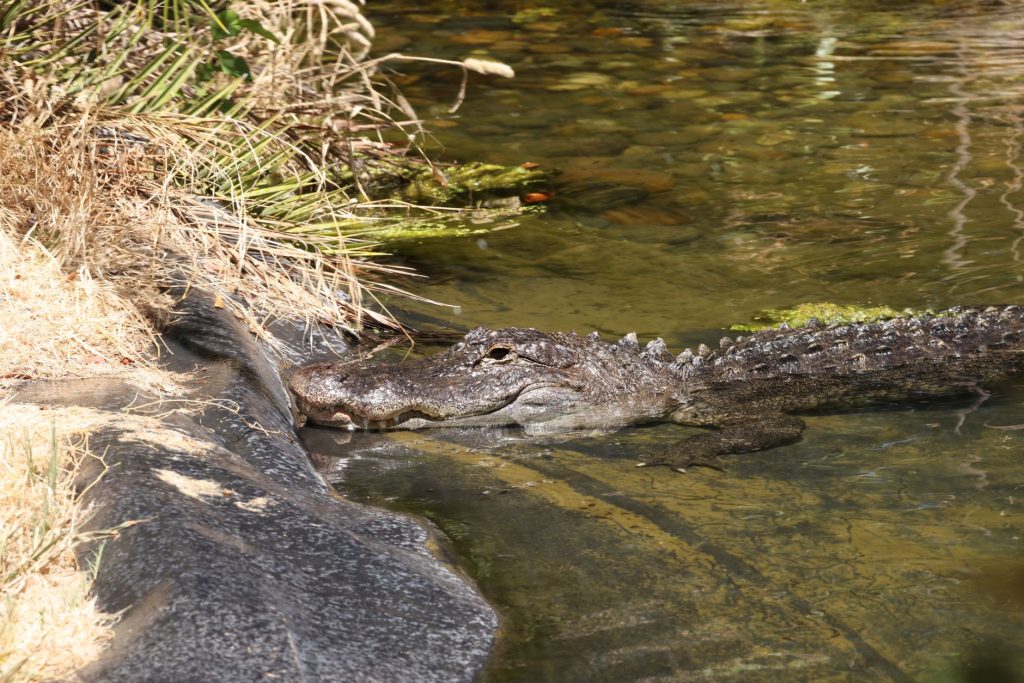
What do you actually do with a full Saturday morning in Jacksonville when the weather is cooperative and you’ve got kids in tow — or honestly, even if you don’t? That question comes up more than people admit, and for years my answer has quietly been the same: drive out to the Jacksonville Zoo and Gardens and spend the first half of your day at Hawkshaw Lagoon.
I’ll start with the obvious — the Jacksonville Zoo is a proper zoo, not a roadside attraction. It covers over 100 acres along the Trout River off Heckscher Drive, and it has been adding serious infrastructure for decades. But the part that keeps pulling me back specifically is the Florida Wetlands section anchored by Hawkshaw Lagoon. It’s the part of this zoo that feels genuinely Floridian rather than generically zoological.
The lagoon itself is a long, open water exhibit where you’ll see American alligators at an honest distance — close enough to understand their scale, far enough to breathe normally. Great blue herons sometimes post up along the railing without a care in the world, which is its own kind of thrill. The boardwalk section winds through reconstructed wetland habitat with native grasses and cypress, and on a cool Tuesday in January or a muted overcast morning in March, the light coming off the water is genuinely beautiful. This isn’t manufactured atmosphere — it looks like the marshes you’d see paddling the St. Johns watershed.
The zoo opens at 9 a.m. most days, and arriving right at opening is worth the effort. By 10:30 on a weekend, the parking situation along Zoo Parkway gets complicated and the main paths start to crowd. Early arrival also means the animals are more active — the African elephants especially, who tend to settle into shade once midday heat rolls in.
Beyond the wetlands, the Range of the Jaguar exhibit is impressive in design, and the Australian Adventure section gives kids the chance to hand-feed lorikeets for a small additional fee (around $3 for a cup of nectar). That particular experience causes a predictable amount of screaming — the good kind, mostly. The Play Park has a splash zone open seasonally that functions as a de facto midday break for families.
Admission runs about $22 for adults and $17 for kids 3–12 as of my last visit, with prices subject to creep. Parking is $5. Members get in free and the annual membership pays for itself fast if you’re local and visit twice — which you will, because this is a place that changes enough across seasons to reward return trips. The winter bird migration adds species to the wetlands section that simply aren’t there in July.
There’s a handful of food options inside — nothing remarkable, standard zoo fare — but the crowds thin considerably if you bring your own snacks and sit at one of the picnic tables near the entrance plaza before you leave. That’s where I usually decompress after three or four hours of walking.
Hawkshaw Lagoon earns the Saturday. The whole zoo earns it, really. But that lagoon, on a quiet morning with the mist still sitting on the water, is the part I think about when someone asks me what Jacksonville actually looks like at its best.