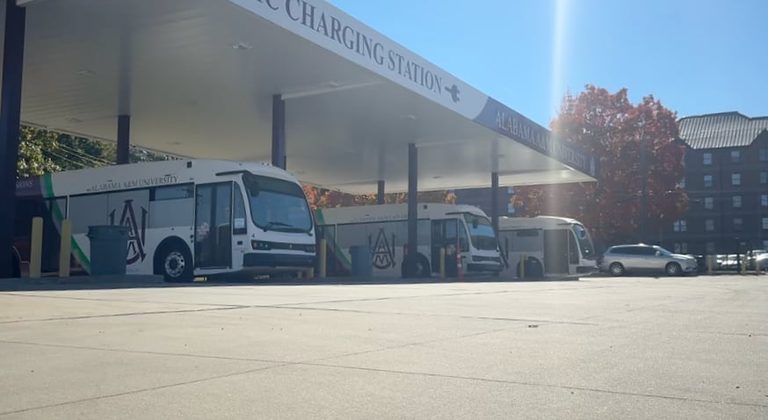
HUNTSVILLE, Ala. – As enrollment at Alabama A&M University climbs by more than 2,000 students over the past four years, the campus is upgrading its electric bus charging infrastructure to keep pace with demand.
More charging spots and a battery storage system
The university will install four additional charging spots beginning in November, with the new equipment slated for completion by February. Director of Transportation Marshall Chimwedzi explained that the second‑generation chargers will cut charging time dramatically, allowing a bus to recharge in roughly two hours instead of the current four‑to‑eight‑hour window.
Alongside the new chargers, A&M is constructing a battery storage system that will capture excess electricity generated by its existing solar farm. The stored solar power can be used after sunset, reducing the school’s dependence on electricity purchased from Huntsville Utilities.
Benefits for students and the environment
Students who rely on campus transportation are already feeling the impact. Junior Aziza Harris‑Mohammed, who does not own a car, said the electric buses make navigating the hilly campus far easier, especially for those living on higher‑level dormitories. “It’d be very hard on your body to be having to walk up and down the hill,” she said.
Sophomore Sudin Pokharel noted that the newer electric buses are larger and quieter than the smaller shuttles used previously, improving the overall ride experience.
Beyond efficiency and cost savings, the university’s goal is a cleaner campus environment. Chimwedzi emphasized that eliminating diesel fumes is a top priority, stating, “The biggest goal right here is to create a clean environment where there are no diesel fumes.”
Looking ahead
With the current expansion, A&M aims to continue adding electric buses to its fleet, targeting a fully electric fleet before 2030. The project aligns with broader efforts to promote sustainable transportation while supporting a growing student body.
Local residents and university stakeholders have welcomed the initiative as a forward‑thinking step that balances environmental stewardship with practical campus needs.
Original reporting: WAFF 48 Huntsville (news) — read the source article.