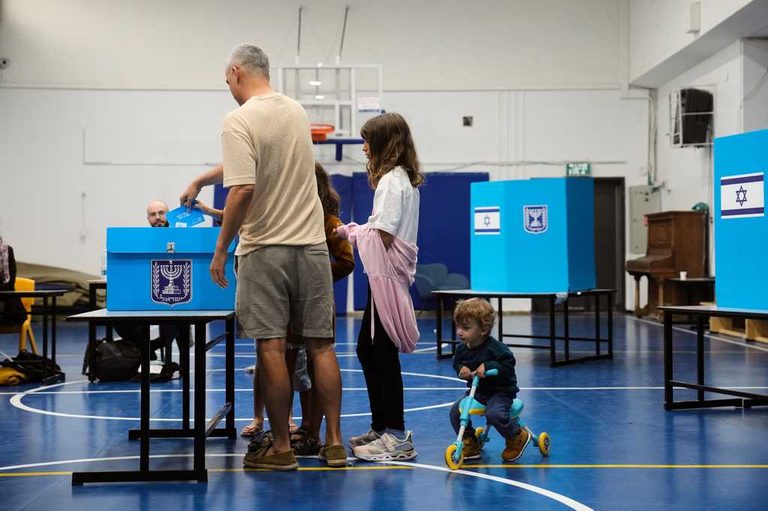
On Tuesday, Israelis headed to the polls in a high‑stakes national election that is widely being treated as a referendum on Prime Minister Benjamin Netanyahu and his government’s response to the Oct. 7, 2023 terrorist attack and the wars that followed. Voters chose among dozens of parties, each hoping to clear the 3.25% threshold needed for representation in the 120‑member Knesset.
Election mechanics and turnout expectations
While 38 parties initially registered, several withdrew before voting day. Roughly a dozen are expected to surpass the threshold and win seats. Israelis cast their votes by placing a slip of paper for their chosen party into a blue envelope; ballots are then counted by hand at each of the roughly 12,000 polling stations, with the process overseen by volunteers and party representatives.
More than 15,000 cameras have been installed at polling sites, and thousands of volunteers are monitoring the vote to deter irregularities. The Central Election Committee reports that over 7.3 million citizens are eligible to vote, including about 330,000 young adults who grew up under the shadow of war.
Voter sentiment on the ground
Emotions ran high across the country. In Jerusalem, voter Noga Mizrahi said, “This is critical. And it’s never been as critical,” after returning from kibbutz Nirim, which was attacked on Oct. 7. In Kiryat Shmona, a stronghold for Netanyahu near the Lebanese border, a man tore down a poster of rival Gadi Eisenkot, underscoring the intensity of the campaign.
Families of victims of the Oct. 7 attack gathered in Tel Aviv for a moment of silence, with mother Yona Adam urging, “Remember all those whose voices are no more.” At a Jerusalem school polling station, voters expressed divergent hopes: some sought change, while others said they trusted Netanyahu to keep them safe.
Reservist Nisim Cohen stated, “He’s not responsible for Oct. 7,” yet added that he wants Netanyahu to continue the wars in Gaza, Lebanon and against Iran until Israelis can sleep peacefully.
Key political figures on the ballot
Islamist party leader Mansour Abbas, 52, voted in his Galilee hometown. Though his party, Ra’am, is expected to win only a handful of seats, Abbas could become a kingmaker if neither Netanyahu’s bloc nor the opposition secures a clear majority. He expressed hope that high Arab‑community turnout could shift the balance of power.
Far‑right National Security Minister Itamar Ben‑Gvir, a prominent Netanyahu ally, also cast his vote, saying, “God willing I will become defense minister; it will be good for the soldiers and good for the people of Israel.”
Netanyahu’s main challenger, former military chief Gadi Eisenkot, campaigned in the southern town of Ofakim, which was attacked on Oct. 7. He warned that any government bearing responsibility for the attack must act immediately, and pledged to dismantle Hamas’s governing structure within 18 months of forming a new administration.
Polls and the road ahead
Opinion polls suggest a tight race with no clear front‑runner, implying weeks or even months of coalition negotiations among roughly a dozen parties. The election outcome will determine whether Netanyahu’s right‑wing coalition remains in power or whether a new alignment emerges.
U.S. President Donald Trump recently voiced support for Netanyahu’s re‑election, a move that Netanyahu has highlighted as evidence of strong U.S.‑Israeli ties.
Implications for Israel’s future
Netanyahu has dominated Israeli politics for nearly two decades. A defeat could end his long tenure, while a victory would reinforce his reputation as a political survivor. The campaign has focused heavily on Netanyahu’s role in the security breakdown of Oct. 7, his policies exempting ultra‑Orthodox Jews from military service, and a 2023 judicial overhaul criticized by some as an assault on democratic institutions.
Beyond the election, Israel continues to face security challenges, including its occupation of parts of southern Lebanon and Syria, and ongoing tensions with Iran. Voters will decide whether to maintain the current security approach or pursue a different path.
As the polls close, the nation awaits the first round of results, which will set the stage for intense coalition talks that could reshape Israel’s political landscape for years to come.
Original reporting: KOAT Albuquerque — read the source article.