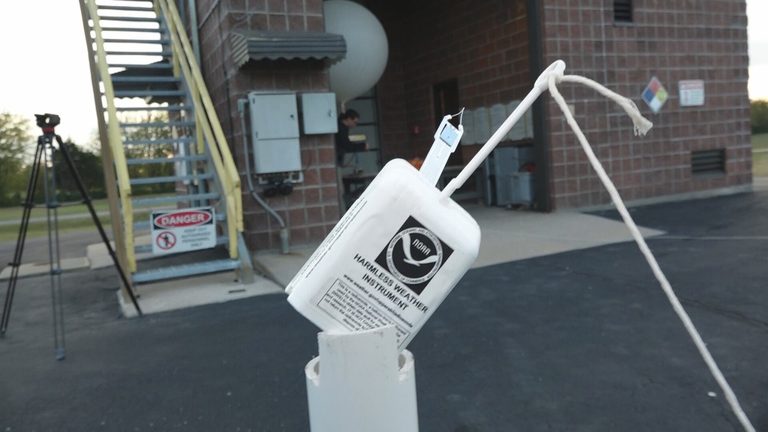
Springfield, Mo. – The National Weather Service (NWS) office here depends on a simple yet trusted tool to keep the community informed about the weather: daily weather balloons. Meteorologists Angelica Soria and her colleague, known as Didio, explain that each day two balloons ascend to roughly 100,000 feet, carrying a radiosonde – a small Styrofoam‑encased instrument that measures temperature, dew point and wind speed.
How the balloons work
Once released, the balloon expands as it climbs, eventually reaching the size of a small house before it bursts. The radiosonde then descends on a parachute, transmitting its data back to the Springfield NWS office in real time. “The temperature and dew point sensor is up here, and the wind sensor is inside the Styrofoam radiosonde, along with the battery,” Soria said. “That little instrument sends the data back to our office, giving us a true picture of the atmosphere right now.”
Why balloons matter in the age of AI
Didio emphasized that while computer models and artificial intelligence are valuable, they are still models and can be wrong. “All models are wrong to some extent, but a weather balloon and direct observation are true. We can look at this with basically 100% confidence and know exactly what the atmosphere is doing at this moment,” he explained. This hands‑on data complements model forecasts, helping forecasters issue more reliable warnings for severe storms, winter weather and everyday conditions.
What happens when a balloon lands
After the radiosonde completes its mission, the balloon pops and the parachute‑filled box falls back to the ground. The NWS does not retrieve the equipment; instead, it encourages anyone who finds a landed balloon to keep it as a personal weather souvenir or dispose of it as they wish. “We do not reuse the radiosonde, the balloon, or the parachute,” Soria said. “So you’re free to keep them or dispose of them as you wish.”
Local residents get a glimpse of science
Occasionally, a Springfield resident discovers a fallen balloon. Recently, a viewer from nearby Cabool sent photos of a recovered radiosonde to KY3, prompting Soria to note that such finds are rare but can become a “weather treasure” for the finder. The NWS office hopes these encounters spark curiosity about meteorology and the science that protects the community.
Continuing the tradition
The daily balloon launches are part of a long‑standing practice that dates back decades, reinforcing the NWS’s commitment to accurate, observation‑based forecasting. By pairing these real‑time measurements with modern modeling tools, Springfield forecasters can provide the public with timely, trustworthy weather information that helps families plan their days, protect property and stay safe during extreme conditions.
For more information about the National Weather Service’s work in Springfield or to report a recovered balloon, residents can contact the office directly.
Original reporting: KY3 Springfield (local) — read the source article.