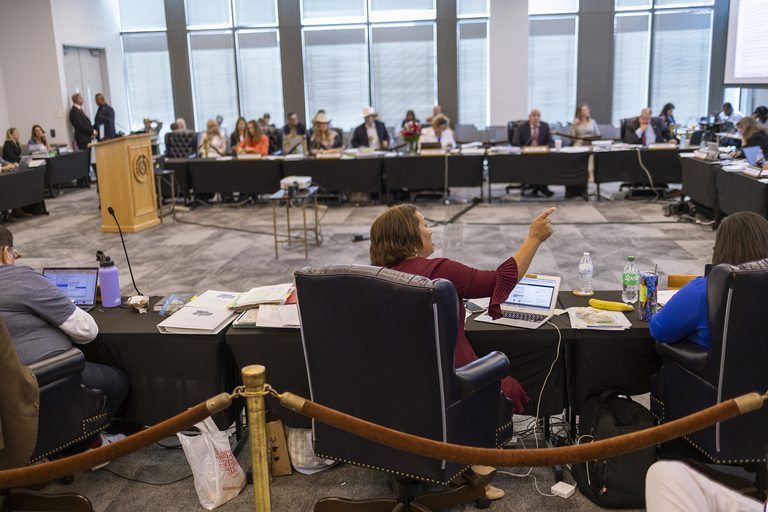
In Texas, the State Board of Education will see a significant turnover this November as three Republican incumbents have announced they will not seek reelection. The open seats are set to be filled by candidates who champion traditional family values, parental rights, and a historically accurate curriculum.
Current board dynamics
The board, which currently holds an 11‑4 Republican supermajority, has been the arena for heated debates over social‑studies content, Bible stories, and a proposed Native Studies course. While most members vote along party lines, a handful of “consensus‑minded” Republicans have occasionally broken ranks to temper the board’s more extreme proposals.
One recent example involved a proposal by Houston Republican Will Hickman to remove the word “brutal” from a description of the Prophet Muhammad’s early military campaigns. Hickman argued that all wars are brutal, but the motion was defeated 8‑4 after pushback from a more hard‑line board member.
Who is running
Four of the nine seats up for election will be contested by conservative candidates who emphasize Christian values and parental oversight:
- Tiffany Nelson – a former Conroe school‑board member whose campaign website declares that Critical Race Theory, gender ideology, and anti‑American narratives have no place in Texas schools.
- Kason Huddleston – a pastor who warned that Islam, socialism and leftist ideas have “weeded their way into the curriculum” and urged voters to support a truly conservative ticket.
- Mindy Bumgarner – married to a Republican state representative, she pledges transparency, protection of parental rights, and a refusal to allow radical political agendas in classrooms.
- Keven Ellis – a Lufkin Republican who chose not to run again, leaving his seat open for a new conservative voice.
All four have received substantial backing from groups that prioritize traditional education, including a $100,000 contribution from Texans for Educational Freedom to Huddleston’s campaign.
Democratic challengers
Opposing the conservatives are three Democratic candidates with backgrounds in teaching and higher‑education support:
- Michelle Palmer – a public‑school teacher who says teachers are “sick of” politicized curricula.
- Ericka Ledferd – a university instructor who argues the board needs members with genuine educational expertise rather than ideologues.
- Amy Taylor – a K‑12 teacher who stresses the need for a balanced curriculum that serves all students.
These candidates criticize recent board actions that they say portray Islam negatively, push Bible lessons into public‑school materials, and marginalize teacher input.
Implications for Texas education
The departure of the three consensus‑oriented Republicans could shift the board further to the right, making it easier for the remaining members to approve textbooks and standards that reflect a Christian‑conservative worldview. Advocates warn that without moderating voices, the board may approve more changes that do not reflect the diversity of Texas’s 5.5 million public‑school students.
“Any one group with a majority of the power can be a destructive thing,” said former board member Evelyn Brooks, a Republican who left the board after an unsuccessful run for governor. Brooks emphasized that children care little about partisan labels; they deserve an education focused on truth and values.
What voters should know
Voters will encounter these races on the November ballot alongside other statewide contests. The board’s decisions affect textbook selection, curriculum standards, and ultimately what Texas children learn about history, government, and faith. Candidates’ platforms are publicly available on their campaign websites, and local media outlets will host forums in the coming weeks.
For parents who prioritize a curriculum grounded in Christian heritage and parental oversight, the conservative slate offers a clear choice. For those who seek a more inclusive approach, the Democratic challengers present an alternative vision.
Regardless of the outcome, the November election will shape Texas education policy for years to come.
Original reporting: Texas Tribune (HLL/CB) — read the source article.