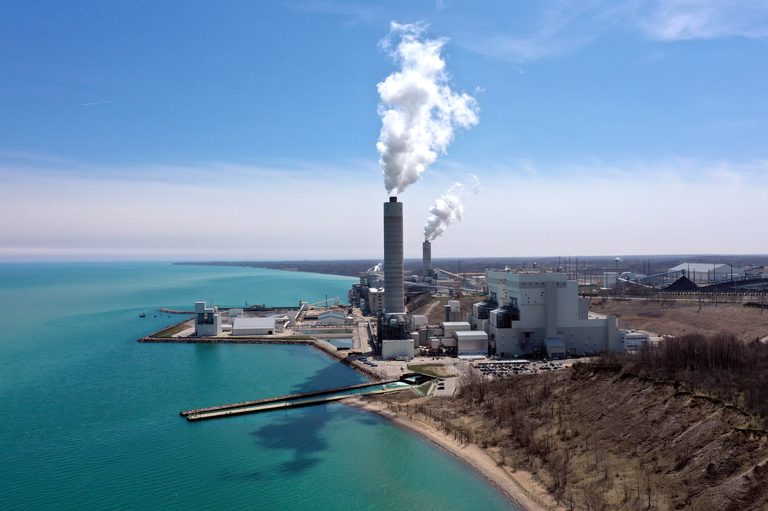
The U.S. Environmental Protection Agency announced a proposal that would shift primary regulatory authority for Wisconsin’s coal ash landfills from the federal level to the state’s Department of Natural Resources (DNR). The change would leave only coal ash ponds under EPA jurisdiction, while the six landfills owned by Dairyland Power Cooperative, Alliant Energy, Wisconsin Public Service and We Energies would be overseen by state officials.
State regulators ready to protect groundwater
In February, the DNR submitted a program for approval that meets or exceeds federal standards for the disposal of coal combustion residuals, commonly known as coal ash. “By submitting this and getting this program approval, it’s that recognition that our regulations are as protective as the federal regulations,” said Kate Strom Hiorns, director of the DNR’s Waste Materials Management Program.
Coal ash contains metals such as arsenic, lead and mercury that can leach into groundwater if not properly contained. The state’s updated rules, first adopted in 2022, incorporate the 2015 regulations introduced during the Obama administration, covering landfill design, groundwater monitoring and closure requirements. The DNR says its program also allows for stricter standards when needed.
Utilities welcome a single set of rules
Utility representatives praised the proposal as a practical step toward efficiency. “Utilities in Wisconsin have been regulated by the state for many years; transferring this particular permitting authority from the federal to state government is a positive step for Wisconsin,” said Katie Thomson, spokesperson for Dairyland Power Cooperative.
Alliant Energy and We Energies also emphasized their commitment to full compliance with both state and federal requirements, noting ongoing groundwater monitoring and remediation efforts at sites where contaminants have been detected.
EPA’s rationale: eliminate duplicate regulation
Anne Vogel, the EPA’s regional administrator for the Chicago office, explained that the agency’s goal is to remove the need for utilities to navigate two separate permitting processes. “It’s really about having to go to two different regulators and eliminating that barrier makes things more efficient, more cost‑effective for the management of these landfills in a protective way,” Vogel told Wisconsin Public Radio.
The Trump administration has been reviewing and revising coal ash rules that were tightened under the Obama and Biden administrations. While some environmental groups argue that dual oversight provides an extra safety net, the EPA believes that a single, well‑crafted state program can achieve the same level of protection without unnecessary bureaucracy.
Environmental groups urge caution
Milwaukee Riverkeeper’s Cheryl Nenn expressed concern that political shifts at both the state and federal levels could weaken oversight. “Given the changes in politics at the state level and the federal level, there’s some benefit to having that dual oversight,” she said, citing recent groundwater contamination at the closed Cedar Sauk Ash Landfill in Ozaukee County.
The DNR has already ordered the utility responsible for that site to conduct additional sampling for boron and sulfate, finding that boron levels exceeded groundwater standards. We Energies reported declining trends in both contaminants, and stated that monitoring indicates no impact on nearby private wells.
Public comment period open
The EPA is currently accepting public comments on the proposal, with a virtual hearing scheduled for November 9. Stakeholders are encouraged to submit feedback on how the state‑level program can maintain or improve protection of Wisconsin’s water resources while reducing regulatory redundancy.
As the state prepares to assume greater responsibility, the DNR emphasizes that its regulations will remain at least as stringent as federal requirements, with the flexibility to adopt even more protective measures when warranted.
Original reporting: Wisconsin Watch — read the source article.