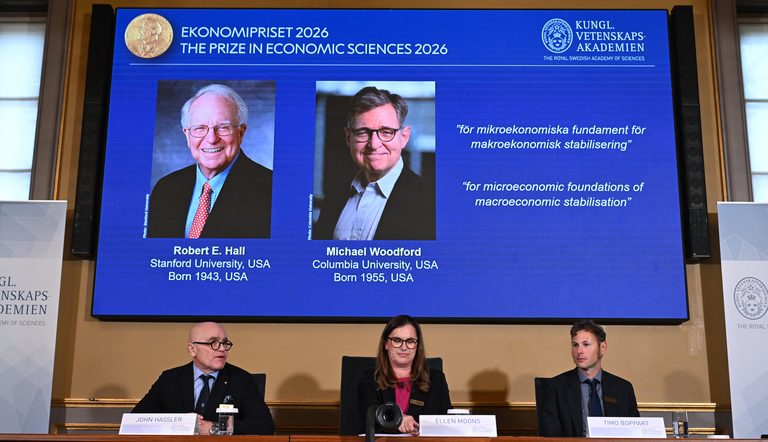
American-born scholars Robert E. Hall and Michael Woodford were honored on Monday with the Nobel memorial prize in economic sciences. Their research on the microeconomic underpinnings of macroeconomic stabilization has been recognized as a critical contribution to the tools used by central banks and governments to navigate economic shocks.
Who are the laureates?
Robert E. Hall is a professor of economics at Stanford University in California, where he has long focused on the interaction between household behavior and broader economic cycles. Michael Woodford, a professor at Columbia University in New York, is renowned for his work on monetary policy and the theoretical foundations that guide central bank decisions.
Why the prize matters
The Royal Swedish Academy of Sciences in Stockholm announced the award, noting that the laureates’ work “has provided us with a stable theoretical foundation for the models that are now used by central banks and governments around the world.” The Academy added that these models help policymakers respond more effectively to crises such as energy disruptions or sudden shifts in consumer spending.
Impact on policy and practice
Both Hall and Woodford’s research has been incorporated into the core frameworks that guide monetary policy. Their models allow policymakers to better assess the likely effects of interest‑rate changes, fiscal stimulus, and other tools aimed at smoothing business‑cycle fluctuations. In practice, this means a more disciplined approach to combating inflation, supporting employment, and maintaining financial stability.
Context of the Nobel memorial prize
The award, formally known as the Bank of Sweden Prize in Economic Sciences in Memory of Alfred Nobel, was established in 1968 by the central bank of Sweden. While it is not one of the original Nobel Prizes created by Alfred Nobel himself, it is presented alongside the traditional Nobel awards each December 10, the anniversary of Nobel’s death.
Last year, the prize recognized researchers who examined how new products and inventions drive economic growth and improve human welfare. This year’s focus on macroeconomic stabilization underscores the importance of sound theoretical foundations for managing the economy in an increasingly volatile global environment.
Prize details
The laureates will each receive a cash award of 12 million Swedish kronor, roughly equivalent to $1.2 million, whether awarded individually or jointly. The prize also includes a gold medal and a diploma.
Other Nobel honors were announced this week in the fields of medicine, physics, chemistry, literature, and peace, highlighting a broad spectrum of scientific and humanitarian achievements.
Reporting from Berlin, Dazio contributed to this story.
Original reporting: NBC Connecticut (Hartford) — read the source article.