There is a moment — and if you have been to Granbury, you know exactly the one I mean — when you round a corner on the square and the Hood County Courthouse rises up in front of you like something out of a fever dream about what Texas used to be. The limestone walls catch the afternoon sun and glow a warm, almost amber gold. The clock tower stands at the center of it all, keeping time over a town that clearly understands the value of holding on to something beautiful.
Built in 1891 and designed by architect W.C. Dodson, the Hood County Courthouse is one of the best-preserved examples of Romanesque Revival courthouse architecture in the entire state. Texas is lousy with courthouse squares, and I say that affectionately, but Granbury’s holds a distinction that most do not: it is listed on the National Register of Historic Places, and the surrounding square remains an active, living hub of commerce and community rather than a museum piece you admire through a chain-link fence.
What I love about this place is that it rewards the slow visitor. Come on a weekday morning when the square is quiet. Stand on the sidewalk across the street and just look at it — the arched windows, the turrets, the intricate stonework that nineteenth-century craftsmen executed without a single power tool. Then walk closer and read the historical markers scattered around the grounds. They tell stories of frontier justice, of a county carved out of the Texas wilderness, of men and women who built something they clearly intended to last.
The courthouse grounds themselves are open to the public and make for one of the most pleasant ten-minute strolls in Hood County. Mature live oaks shade the walkways, and in spring, the flower beds along the perimeter are properly lovely. Bring a camera — not just your phone, though your phone will do fine — because every angle produces a postcard. The clock tower especially, shot from below looking up at dusk, is genuinely cinematic.
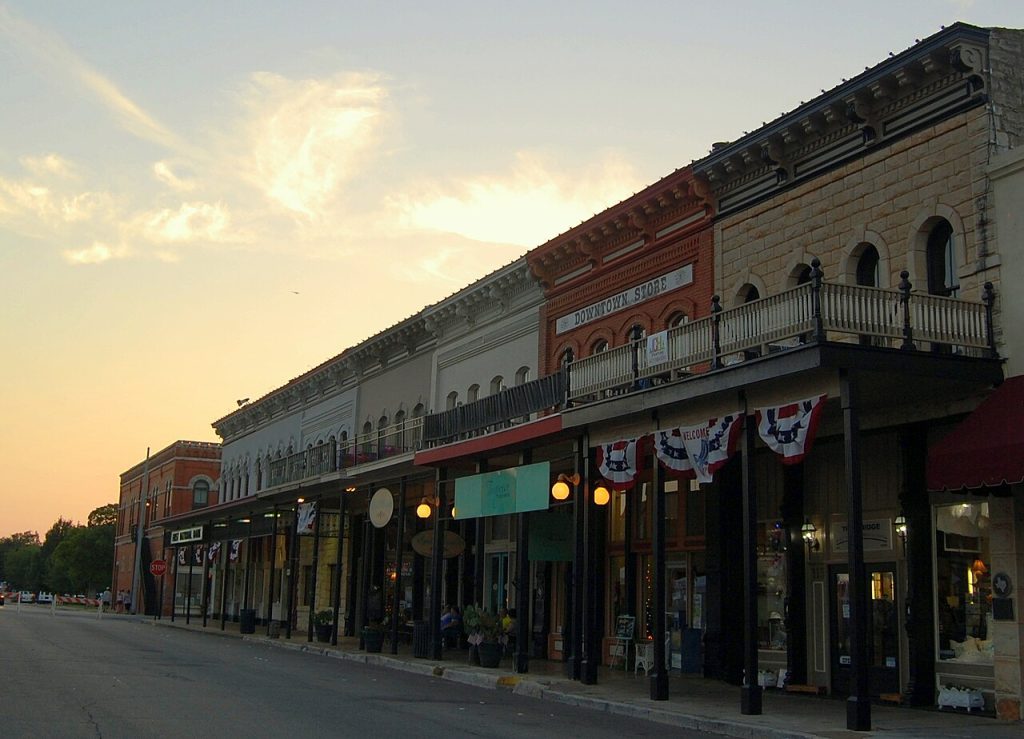
What makes this landmark function as more than a history lesson is its context. You are standing at the geographic and spiritual center of Granbury. The restaurants, the shops, the wine bars, the antique dealers — they all radiate outward from this building. Spend an hour here and you have oriented yourself to the entire town in a way that no map app can replicate.
First-time visitors to Granbury often ask locals where to start. The answer is always the same: the square. And on the square, the courthouse is the compass. Everything else falls into place once you have stood in its shadow and understood that this is a town that chose, deliberately and consistently, to honor what it built. That choice shows, and it is worth making the drive to see it for yourself.