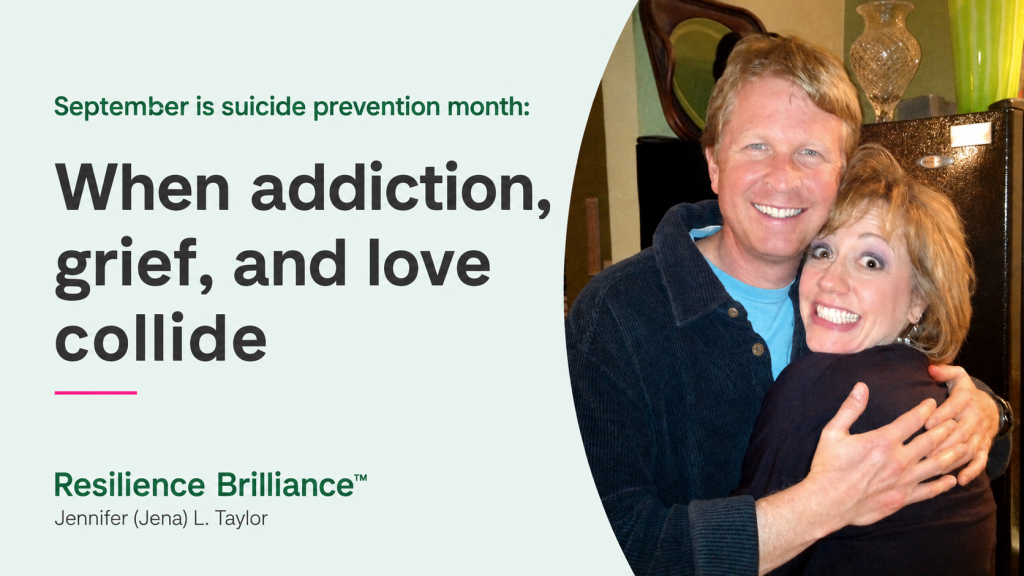
September is suicide prevention month, and this is personal.
This year I’m choosing to say more out loud.
Not because it’s easy. Not because I have all the answers. And certainly not because grief wraps itself into something neat and polished with time.
I’m sharing because suicide, alcohol addiction, and traumatic grief still carry too much silence. And silence does not save lives.
The man I loved was more than his addiction
Almost five years ago, Michael, my long-time partner and the man I was married to in my heart, died by suicide during a severe alcohol-related crisis while we were trying to get him psychiatric help. In my journal, I wrote: “Addiction stole this beautiful soul.”
That sentence still feels true.
But it is also incomplete, because Michael was not only his addiction. He was not only the way he died. He was not only the worst day of his life.
There was sober Michael, the man I loved deeply. The tender, funny, intelligent, playful man with beautiful blue eyes. The man who loved tennis, backgammon, meaningful conversations, and birthday lobster. The man who could make ordinary moments feel like home.
And then there was the alcohol-altered Michael. The version consumed by relapse, withdrawal, shame, fear, and panic. Michael himself once told me that “the booze talks.” I have carried that phrase with me because anyone who has loved someone with alcohol use disorder knows the terrible truth inside it: addiction can use a person’s voice while distorting the person you know.
That does not erase the harm. It does not excuse the chaos. But it helps explain the heartbreak.
Loving someone with an active addiction is like being in relationship with someone whose baseline is regularly moving. It’s predictable and unpredictable simultaneously.
That is one of the hardest parts to explain to people who have not lived it. You are loving a person and fighting a disease at the same time. You are trying to respond to the person you know while managing the crisis the disease creates. You are constantly trying to determine what is love, what is enabling, what is emergency, and what is survival.
The call that changed everything
On the day Michael died, I was waiting for news from a wellness check. I had Christmas ornaments spread across the living room. I was attempting to stay constructive while waiting instead of worrying about something I couldn’t control. I expected him to call and ask if I “had one more in me,” the way he asked when he wanted help detoxing and returning to sobriety.
Instead, I received the call that changed my life.
In my journal, I wrote that his death “crumpled me like an accordion.” That is exactly what happened. My body folded before my mind could comprehend the words. I remember sobbing, screaming “No,” and then somehow pulling myself together enough to ask the only question that mattered: “Is he alive?”
He was not.
That moment split my life into before and after.
I share this carefully because suicide prevention content must never sensationalize someone’s death. The details of how someone died are not the lesson. The lesson is that suicidal threats during relapse, intoxication, withdrawal, or psychiatric crisis must be treated as a medical emergency.
Even if you believe the person would “never do that” when sober.
Even if the person has said things before and survived.
Even if part of you thinks this is the addiction talking.
Especially then.
Because the disease state may not reflect the person’s grounded, sober self, but the danger is still real.
Suicide and addiction are still hard to talk about
The stigma around suicide is heavy. The stigma around alcohol addiction is heavy. When the two are intertwined, the silence gets even heavier. People do not know what to say to a grieving person let alone a grieving person where there’s stigma attached. They lower their voices. They avoid the subject. Sometimes they reduce the person to the addiction or the death.
But Michael was a whole person.
He was loved. He mattered. He struggled. He hurt people. He helped people. He laughed. He dreamed. He fought. He relapsed. He did his best. He was more than the worst thing that happened.
And those of us left behind are more than survivors of a tragedy. We are witnesses. We are grievers. We are people who loved greatly and now have to learn how to live with the unanswered questions.
In my journal, I wrote: “When you love greatly, you grieve greatly.” I still believe that. Grief is the price of love, and it is a price I would still pay to have known the sober Michael.
A 4-part suicide prevention month series on alcohol addiction, suicide loss, stigma, grief, and the community support that helps survivors keep living
Over the next several weeks, I will be sharing a 4-part series about Michael, alcohol addiction, suicide loss, stigma, and what it means to keep living after the unimaginable.
The series will include:
-
The Two Michaels
The man I loved and the disease that spoke through him. -
The Call
What it felt like to receive the news and collapse into the before-and-after of suicide loss. -
The Double Stigma
Why we need to talk more honestly about both suicide and alcohol use disorder. -
Grieving Forward
How grief lives in objects, memories, anniversaries, and eventually, if we are willing, renewed joy.
I am not sharing this because I want pity. I am sharing because someone reading this may love a Michael. Someone may be a Michael. Someone may be minimizing a crisis because they think the person “doesn’t mean it.” Someone may be grieving a loss they still do not know how to talk about.
If that is you, you are not alone.
If someone you love is threatening suicide, especially during intoxication, withdrawal, relapse, or psychiatric distress, do not wait. Call for help. Stay connected. Bring in professionals. Treat it as urgent.
And if you are grieving someone who died by suicide or addiction, please know this: their death is not the sum of their life, and your grief does not have to follow anyone else’s timeline.
As I wrote in my journal, “Survivors learn how to live without their person; and more importantly, how to find joy again.”
I am still learning. I am still grieving albeit much differently than the raw state. I am still here. Life doesn’t stop because someone we love died. That’s a hard and crucial part to understanding what it means to “survive” the loss of someone we love.
And this September, I am choosing to speak.
If this story meets you somewhere tender, I hope you’ll take one next gentle step: check on someone you love, share this with someone who may need it, or remember that grief, addiction, and suicide loss deserve more compassion than silence.
Free Community Resource
September is Suicide Prevention Month, and one thing I know from experience is this: people need support before they reach a crisis point, and survivors need support long after everyone else assumes they are “better.”
I’m offering a free virtual workshop called Resilience Reset on Thursday, September 17 at 12 PM. It is free to attend and designed for people navigating grief, trauma, burnout, life transition, or emotional overwhelm.
If you or someone you love is in immediate danger or considering suicide, call or text 988 in the U.S. or contact local emergency services.