There’s a moment, somewhere between the second and third object the telescope swings to, when Durango stops being a mountain town and becomes something closer to a cosmic outpost. That moment happened to me on a Tuesday evening at the Fort Lewis College Observatory, standing on a windswept hilltop above campus with about forty strangers, all of us craning our necks at the same patch of sky, all of us suddenly very quiet.
The Fort Lewis College Observatory sits on the mesa above downtown Durango, tucked behind the campus buildings on a rise that gets you just enough elevation and enough distance from the streetlights to make a real difference. The college opens the observatory to the public on select clear evenings throughout the year — these are the Public Star Party nights, hosted by FLC’s Physics and Engineering Department, and they are entirely free. No tickets, no reservations, just show up before dark and follow the crowd to the dome.
What makes the evening work is the people running it. The faculty and student volunteers here are genuinely enthusiastic without being condescending. They’ll walk you through what you’re looking at — Saturn’s rings, a globular cluster, the Orion Nebula depending on the season — and they’ll answer every question, including the ones that start with “okay, but is that actually a planet or am I just seeing things?” You are not just seeing things. That really is Saturn, and yes, those really are the rings, and no, you will never quite get used to seeing it with your own eyes no matter how many times someone shows you a photograph.
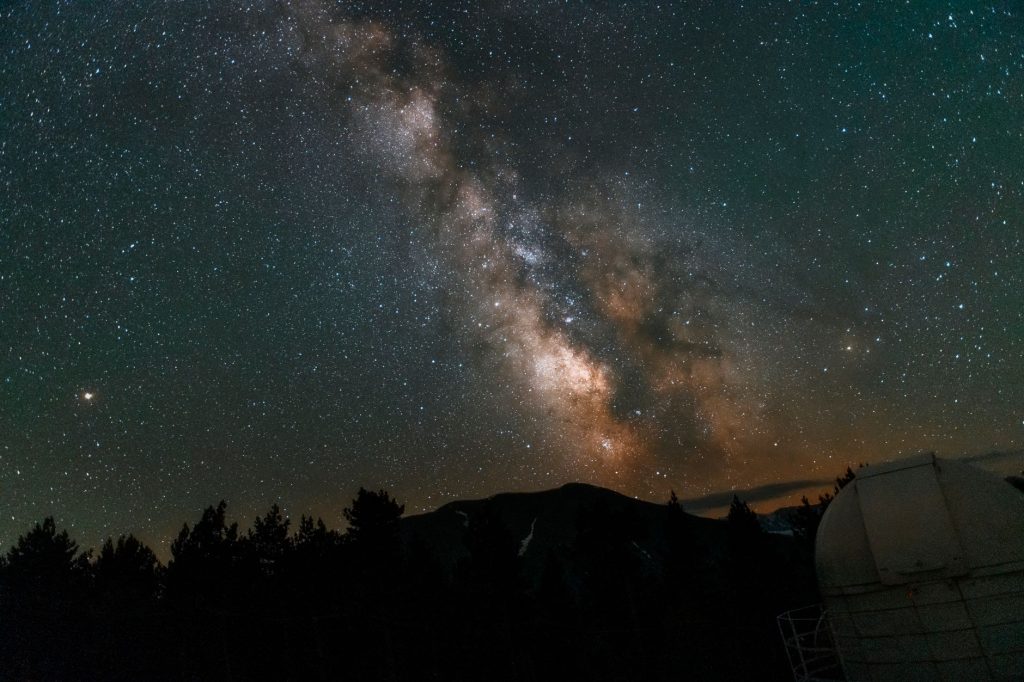
The high-altitude desert air around Durango is some of the best in Colorado for stargazing. At roughly 6,500 feet with low humidity and minimal light pollution to the north and west, the skies here are legitimately dark by the standards of any front-range city dweller. On a moonless night, the Milky Way arcs overhead in a way that makes you feel slightly embarrassed about how long you’ve gone without looking up.
Dress warmer than you think you need to. Even in late summer, the temperature on that mesa drops fast after sunset, and you’ll be standing still. Bring a red-lens flashlight if you have one — white lights wash out your night vision and the volunteers will gently remind you of this. Kids are not only welcome but genuinely catered to; the staff have a patience and a gift for explanation that makes the whole event accessible to an eight-year-old and interesting to a retired engineer simultaneously.
If you’re visiting Durango and you’ve already done the train, the river, and the trails, do yourself the favor of saving one evening for this. The mountains are magnificent in daylight. But under a properly dark sky on a Fort Lewis hilltop, with Jupiter sitting fat and bright just above the ridge and a student astronomer walking you through the moons you can actually see, Durango reveals a dimension most visitors never find. It costs nothing except the willingness to look up.