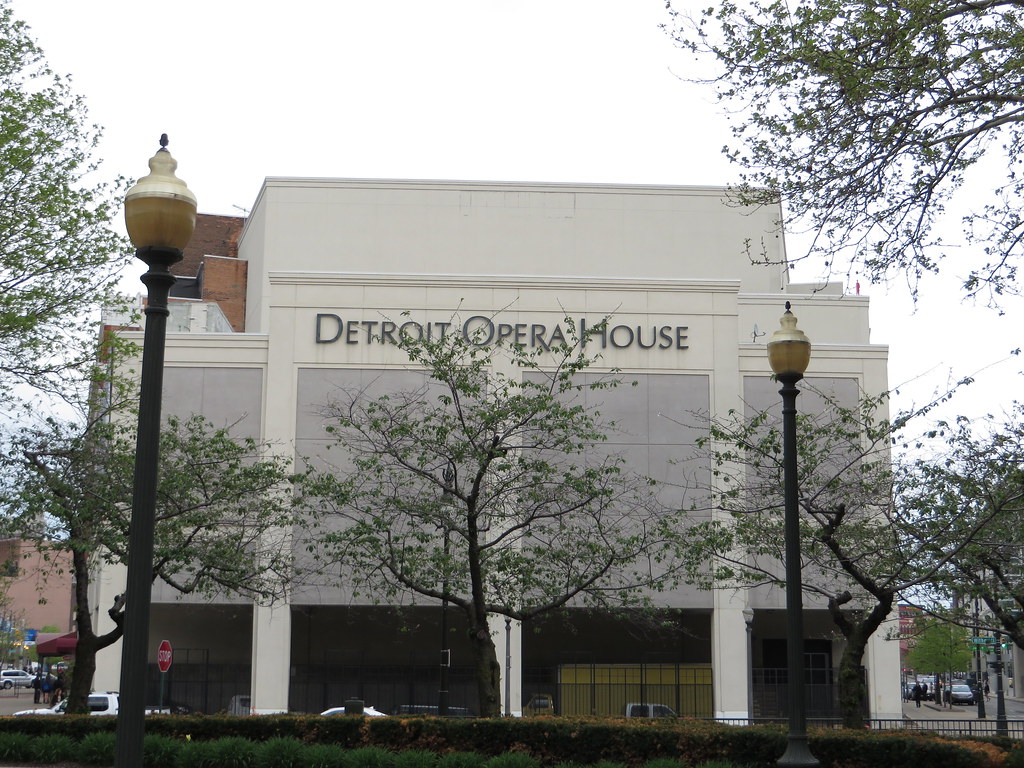
There is a moment, right after you push through the heavy brass doors of the Detroit Opera House on Broadway Street in the heart of downtown, when the city outside simply disappears. The traffic, the construction cranes, the honking — all of it falls away, replaced by marble floors, gilded archways, and the particular hush of a building that knows it is doing something important. That feeling alone is worth the ticket price.
The Detroit Opera House has been anchoring the city’s cultural life since it opened in 1922 as the Capitol Theatre, one of the most opulent movie palaces in the Midwest. Today, fully restored and operated by the Michigan Opera Theatre, it seats nearly 2,800 people across five levels of rich crimson and gold. It is the kind of interior that makes you sit up a little straighter the moment you walk in — not because anyone is telling you to, but because the room demands it in the best possible way.
The programming here spans far more than classical opera. Yes, you can catch a full-scale production of Verdi or Puccini delivered with genuine world-class talent — Michigan Opera Theatre has built a serious national reputation, and the acoustics in this hall reward that ambition completely. But the Opera House also hosts ballet, Broadway touring productions, jazz concerts, and the occasional pop crossover act that fills those five balconies to the rafters. It is genuinely one of those venues where you could come back four times a year and never see the same kind of show twice.
The building sits at the northern end of Detroit’s Theater District, which means a night here slides naturally into a broader downtown evening. Grab dinner beforehand at one of the restaurants along Washington Boulevard or Park Avenue, then walk over in time for a pre-show drink at the Opera House bar, where the crowd tends to be a cheerful mix of longtime subscribers, first-timers on a date, and out-of-towners who stumbled onto a ticket and can barely believe their luck.
First-timers should know a few practical things. Parking is plentiful in the structures along Madison and Broadway, and ride-shares drop off directly in front. The box office staff are genuinely helpful if you call ahead with questions about seating — the upper balconies are steep but the sightlines are surprisingly good, and those seats often carry the best prices in the house. Dress codes are relaxed; you will see everything from black tie to nice jeans, and nobody blinks either way.
What strikes most people on their first visit is not the grandeur, exactly — it is the sense that this place was saved by people who refused to let it go. In the 1990s, when downtown Detroit was fighting hard battles, the Michigan Opera Theatre undertook a painstaking, multi-year restoration that brought every inch of the building back to its original splendor. That act of civic faith is visible in every restored plaster medallion, every inch of re-gilded balustrade.
Detroit has a habit of astonishing people who show up with low expectations. The Detroit Opera House is one of the finest examples of that habit in the entire city. Book a night, dress up a little if you feel like it, and let the curtain do the rest.