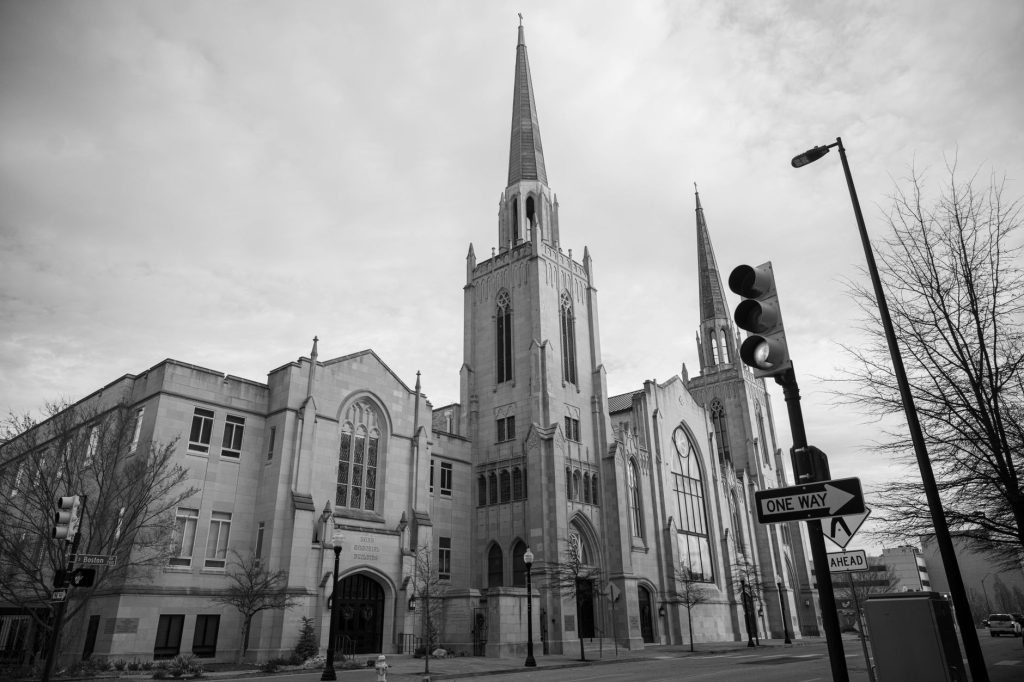
Let me set the scene. It’s a Tuesday evening in early autumn, and I’m standing on the corner of 13th Street and Robinson Avenue in Midtown Oklahoma City, looking up at a building that seems to belong somewhere in the English countryside rather than the southern plains. The Gothic Revival stonework of All Souls’ Unitarian Church catches the last golden light of the day, and before I’ve even stepped inside, I’m already reconsidering every assumption I ever made about a night out in OKC.
All Souls’ has been a fixture of Oklahoma City’s cultural and spiritual life since 1921, and the congregation has long understood something that many institutions quietly forget: beauty and community are not separate pursuits. The sanctuary itself is the first thing that will stop you cold. Soaring vaulted ceilings, warm wood pews worn smooth by a century of use, and stained glass windows that transform afternoon sunlight into something close to liturgical — it’s an interior that earns genuine silence from the moment you cross the threshold.
But what draws me back, again and again, is the church’s commitment to live performance. All Souls’ hosts a remarkably active calendar of concerts, choral evenings, lecture series, and community cultural events that are open to the public regardless of faith tradition or background. The music program here is no afterthought — the choir director is a trained professional, and the acoustic properties of that stone sanctuary make even a modest ensemble sound like a full cathedral choir. When they perform Bach or Britten or contemporary American choral works, the sound wraps around you from every direction, and the effect is nothing short of transporting.
The congregation draws a wonderfully eclectic crowd to these events. You’ll find retired schoolteachers sitting next to young architects, longtime OKC residents introducing out-of-town guests to a side of the city they never expected. There is no dress code, no pressure, and frequently no admission charge — though donations are warmly welcomed and genuinely appreciated.
Outside of musical events, the church also hosts lectures, social justice forums, and arts programming that reflect its longstanding commitment to an open intellectual life. If you time your visit right, you might catch a chamber music evening in the fellowship hall, an art exhibition mounted along the corridors, or a community dinner that feels more like a neighborhood reunion than any formal event.
Midtown Oklahoma City has transformed considerably over the past decade, and All Souls’ sits comfortably at the center of that energy — surrounded by coffee shops, independent restaurants, and the kind of walkable streetscape that makes an evening feel genuinely spontaneous. Arrive early, wander the neighborhood, then settle into one of those old wooden pews and let the music do what only live music in a resonant stone room can do.
Oklahoma City surprises people. That’s its gift. And All Souls’ Unitarian Church is one of the finest surprises this city keeps quietly offering to anyone willing to look past the obvious itinerary. Don’t wait for a special occasion. Check their calendar this week and make a Tuesday evening into something you’ll actually remember.