Most people drive past it without a second thought. A flat stretch of West Texas highway, a weathered brown sign, a gravel parking lot. But pull off the road and walk just a few hundred yards, and you are standing inside one of the best-preserved meteor craters on the entire North American continent. The Odessa Meteor Crater sits just a short twenty-minute drive west of Midland on I-20, and it is the kind of place that quietly rewires the way you think about the ground beneath your feet.
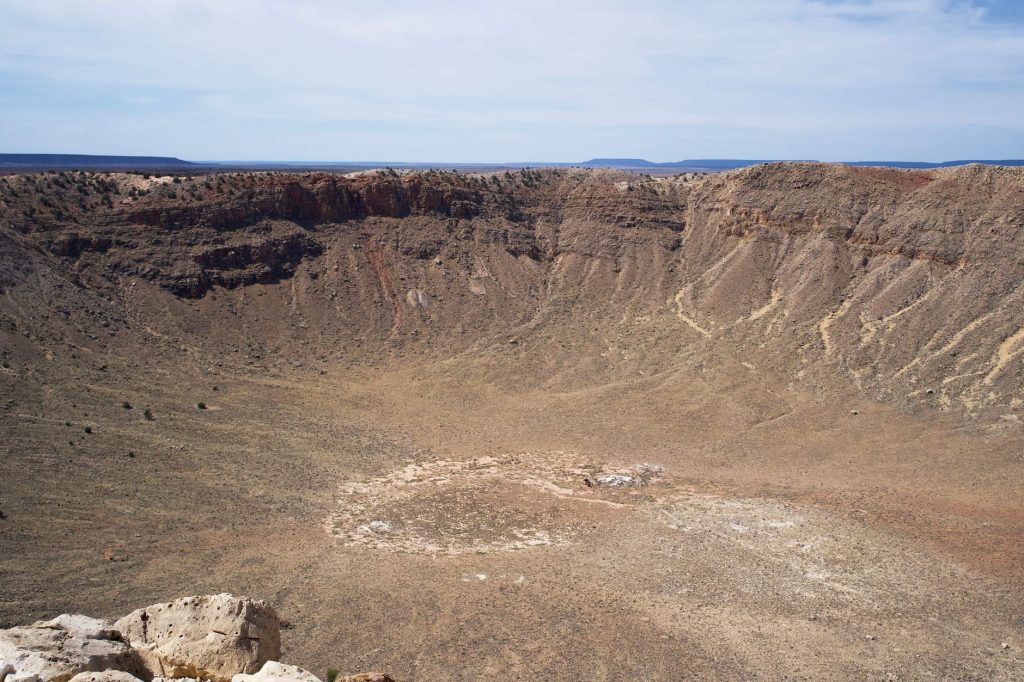
Let me set the scene. Roughly 63,000 years ago, a chunk of iron meteorite came screaming out of the sky at tens of thousands of miles per hour and slammed into what is now the Permian Basin. The main crater measures about 500 feet across and originally dipped nearly 100 feet deep — though thousands of years of sediment have filled it in considerably. What you see today is a broad, bowl-shaped depression ringed by a low rim of displaced earth, surrounded by the big, open West Texas sky. It sounds subtle, but standing at the rim and looking across the bowl, you feel the weight of deep time in a way that no photograph quite captures.
The site is managed as a small but genuinely thoughtful nature and heritage preserve. There is a modest interpretive museum on the grounds where you can examine actual recovered meteorite fragments, read about the science of impact geology, and learn how local ranchers first stumbled across the crater in the early twentieth century and had absolutely no idea what they were looking at. The exhibits are concise and well-organized, great for adults and curious kids alike.
A paved walking trail loops around the main crater and leads past two smaller, lesser-known satellite craters nearby, which most visitors completely overlook. Follow the full loop and you will cover about a third of a mile — easy going even in the West Texas heat, though you will want to bring water and wear a hat, because shade is a rare luxury out here. Early morning visits in spring or fall offer the most comfortable temperatures and the best light for photography.
Admission is free, which feels almost too good to be true for a site of genuine scientific and historical significance. A small donation box at the entrance helps keep the museum and grounds maintained, and it is well worth dropping a few dollars in on your way out.
For Midland visitors looking to stretch beyond the city limits for an afternoon, this is as compelling as it gets. You do not need to be a geology enthusiast or a space nerd to feel something standing in that crater. You just need to be the kind of person who appreciates the extraordinary hiding inside the ordinary — and out here in West Texas, that is exactly the kind of traveler who fits right in.