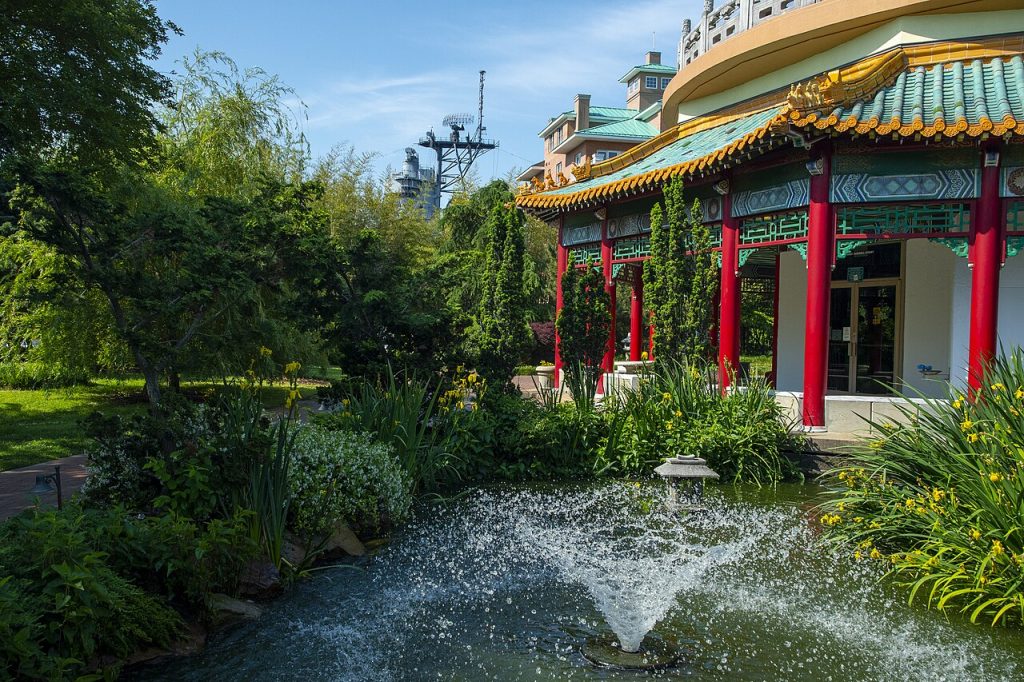
Tucked along the Lafayette River in the heart of Norfolk’s historic Ghent neighborhood, the Pagoda & Oriental Garden is the kind of place that stops you mid-stride and makes you wonder how you’ve never heard of it before. This isn’t a replica or a theme-park approximation — it’s a genuinely beautiful, thoughtfully maintained Japanese-inspired garden that feels like a world apart from the bustle of downtown Norfolk, even though it sits just minutes away.
The garden traces its origins to 1906, when it was created as part of a larger leisure complex meant to give Norfolk residents a refined escape. The pagoda itself — a graceful, multi-tiered structure painted in rich red and green — anchors the space visually and historically. It’s been lovingly restored over the decades, and today it stands as one of the oldest Japanese-style structures in the American South. That alone makes it worth a visit, but it’s really the whole atmosphere of the place that lingers with you long after you’ve left.
Step through the garden’s entrance and the city seems to exhale. Wisteria and weeping cherry trees frame winding stone paths that loop around a central pond. Koi drift through the water in slow, unhurried arcs. Wooden footbridges arch over the glassy surface, and if you time your visit right — spring is spectacular — the flowering trees create a canopy of soft pink and white overhead. It’s the kind of setting that makes you slow down instinctively, reach for your camera, and then quietly put it away because you’d rather just be present.
The garden is free and open to the public year-round, which feels almost extravagant given how genuinely lovely it is. You’ll find families here on weekend mornings, couples strolling in the early evening light, and solo visitors settled on a bench with a book or just a cup of coffee. There’s no admission gate, no gift shop, no timed entry — just a beautiful urban sanctuary that trusts you to enjoy it responsibly.
Because it’s city-maintained and not heavily commercialized, the Pagoda & Oriental Garden has retained a quiet authenticity that’s increasingly rare. It doesn’t try too hard. It simply exists as a well-kept, genuinely serene corner of a city that has far more depth than many visitors expect to find.
If you’re building an itinerary for a Norfolk trip, pencil this one in on a morning when you want to start slowly. Walk the paths, linger on the bridge, watch the koi. Grab a coffee from one of the nearby Ghent cafés on your way over and make an unhurried hour of it. You’ll leave feeling like you’ve found something real — and you’ll be right.