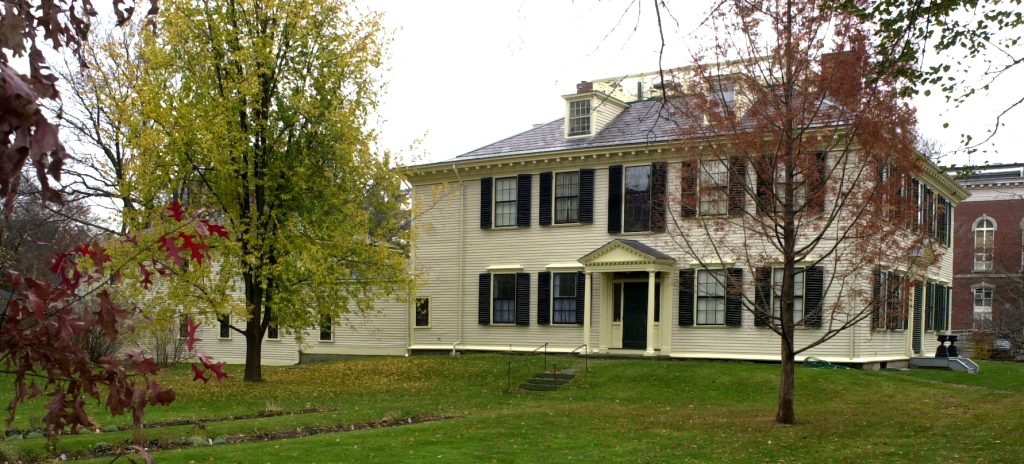
Jamaica Plain does not lack for personality. Walk down Centre Street on any given Saturday and you will pass a dozen independent cafés, a farmers’ market overflowing with local honey and heirloom tomatoes, and more murals than you can photograph before your phone dies. But tucked just off the main drag, behind a low stone wall and a sweep of old elms, stands something that stops even the most seasoned Boston neighborhood-hopper in their tracks: the Loring-Greenough House, a Georgian Colonial mansion that has been quietly anchoring the corner of Sedgwick Street since 1760.
Let me set the scene. You push open a wrought-iron gate, walk up a short brick path, and suddenly the noise of the city falls away. The house itself is broad-shouldered and dignified, painted a soft yellow that catches afternoon light beautifully. It does not shout for your attention. It simply stands there, completely at ease, as if it has seen enough of Boston’s history to know it has nothing left to prove — and at 265-plus years old, it most certainly has.
Built for wealthy merchant Joshua Loring, the house passed to the Greenough family in the early nineteenth century and remained in their hands for well over a century. That continuity is part of what makes it so remarkable. Many of Boston’s historic properties have been carved up, sold off, or stripped of their original character. The Loring-Greenough House, now steward by Jamaica Plain Tuesday Club, has been carefully preserved and is one of the few remaining examples of pre-Revolutionary Georgian domestic architecture in the city. Walking through its rooms feels less like visiting a museum and more like stepping into a household that simply paused for a moment and asked you to look around.
The interior is full of period furnishings, original woodwork, and details that reward slow looking — wide-plank floors worn smooth by generations of footsteps, a graceful central staircase, fireplaces that you can practically smell the wood smoke in. Docents are knowledgeable and genuinely enthusiastic, the kind of guides who remember the small, human stories rather than just reciting construction dates.
The grounds deserve equal attention. The rear garden is a quiet, semi-formal space with old plantings and a sense of genuine tranquility. In warmer months it hosts occasional outdoor events, from historic lectures to community gatherings, all of which feel exactly right in this setting.
Getting there is easy. The Stony Brook stop on the Orange Line puts you about a ten-minute walk away, and the surrounding Jamaica Plain neighborhood is absolutely worth exploring before or after your visit. Stop in at one of the nearby restaurants on Centre Street, or continue on foot toward Jamaica Pond for a complete afternoon.
Admission is modest, the staff is welcoming, and the experience is the kind that lingers. Boston has no shortage of history, but it is not always this intimate, this well-tended, or this easy to simply enjoy. The Loring-Greenough House is a reminder that some of the city’s best stories are found not on the Freedom Trail, but on a quiet residential corner in a neighborhood most visitors have not yet thought to explore.