There is a moment, sometime around early evening, when the last slant of Chihuahuan Desert sunlight catches the pale stone facade of the Cathedral of Saint Patrick and the whole building glows like something out of a fever dream about the American Southwest. If you have never stood in downtown El Paso and looked up at those twin towers rising above San Jacinto Plaza, you are missing one of the most quietly dramatic scenes in all of Texas.
San Jacinto Plaza sits at the very heart of El Paso’s historic downtown, bounded by Mesa Avenue and Oregon Street, and it has been the social and spiritual anchor of this city since the 1880s. The plaza itself is a proper old-world square — shaded by mature trees, lined with iron benches, and anchored by a central fountain — the kind of public space that most American cities accidentally demolished in the name of urban renewal and now desperately wish they still had. El Paso kept theirs, and it shows.
The Cathedral of Saint Patrick, which faces the plaza from its commanding position on North Mesa Street, was completed in 1917, though the parish itself dates back to 1882, making it the oldest Catholic diocese in Texas. Walking through its heavy wooden doors is a full sensory shift. The interior is cool and hushed, with high vaulted ceilings, intricate stained glass windows that filter desert light into jeweled pools of color across the pews, and an ornate main altar that speaks to the deep Hispanic Catholic heritage that shaped this entire region. Even visitors with no religious affiliation tend to go quiet in here, and that quiet says everything.
What makes this pairing of the plaza and the cathedral so worth your time is not just the architecture — it is the living texture of daily El Paso life that surrounds it. On weekday mornings, office workers cut through the plaza with coffee in hand. On weekends, families spread out on the grass, vendors sell elotes and paletas from carts along the perimeter, and local musicians sometimes set up near the fountain. This is not a museum piece or a tourist tableau. It is a working, breathing center of civic life in a city that takes its history personally.
Spend an afternoon here and you begin to understand why El Paso feels different from other Texas cities. The border is not a backdrop — it is woven into the architecture, the faces, the language drifting across the plaza, the centuries-old church at the square’s edge. The cathedral’s weekend masses draw an enormous and multigenerational congregation, and even if you simply sit on a bench outside and watch people file in and out, you get a sense of communal rootedness that is increasingly rare.
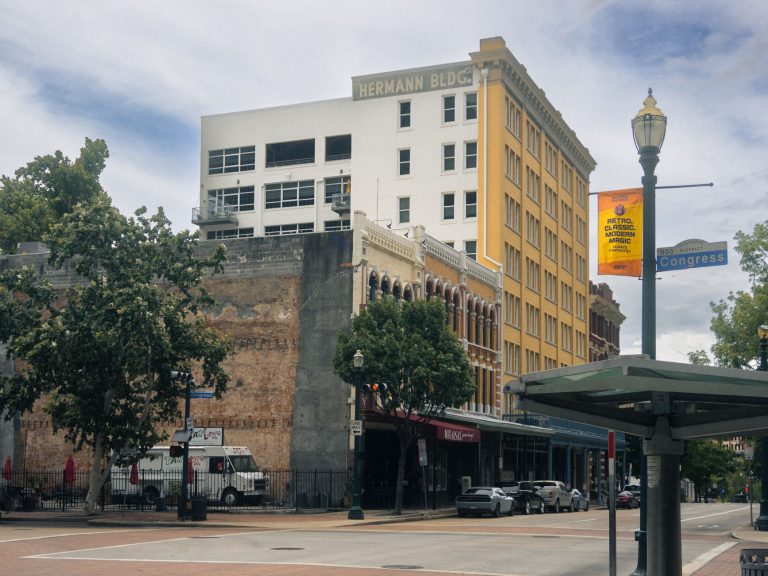
Before you leave, walk the perimeter of the plaza slowly. Look at the historic buildings that frame it — the old federal courthouse, the art deco facades, the murals that have started appearing on adjacent walls in recent years. Then look back at those cathedral towers one more time against whatever the sky is doing, because in El Paso the sky is almost always doing something worth watching. This little square mile of downtown is, in many ways, the story of the whole city compressed into a single walkable afternoon.