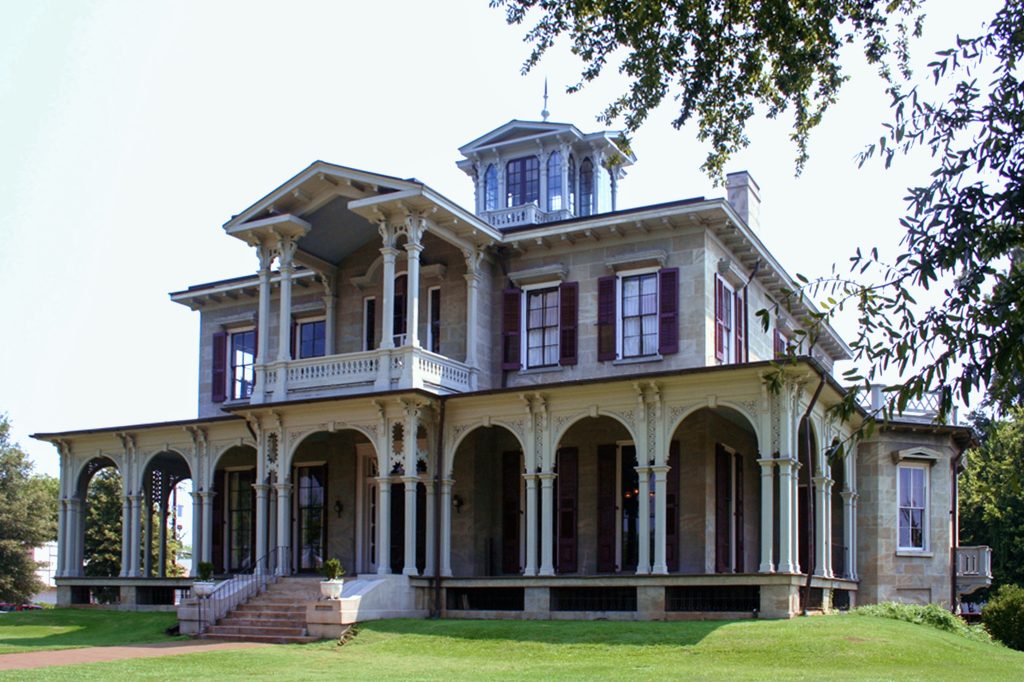
There are buildings that simply hold space, and then there are buildings that hold stories. The Jemison-Van de Graaff Mansion, tucked along Greensboro Avenue in Tuscaloosa’s storied Druid City neighborhood, falls squarely into the second category. From the moment you step through its wrought-iron gate and onto the brick walkway, you get the distinct feeling that this place has been quietly waiting to tell you something remarkable.
Built in 1862 for Robert Jemison Jr., one of Alabama’s most prominent antebellum statesmen and entrepreneurs, the mansion is an extraordinary example of Italianate architecture — a style that was genuinely fashionable and forward-thinking for its era. The symmetrical facade, bracketed cornices, and wide wraparound veranda give the home an almost theatrical grandeur, and yet it never feels cold or unapproachable. This is a place that was built for living, for entertaining, and for making an impression — and more than 160 years later, it still manages all three with considerable grace.
Jemison was no ordinary figure in Alabama history. He was a railroad magnate, a planter, and a Unionist who famously opposed secession even as the Confederacy took shape around him. Walking the grounds and peering into the preserved rooms, you begin to appreciate the complexity of the era in a way that no textbook can quite replicate. The mansion survived the Civil War largely intact — a rare feat — and went on to become home to the Van de Graaff family, whose own contributions to science and civic life added yet another fascinating chapter to the property’s history. Robert Jemison Van de Graaff, the inventor of the Van de Graaff generator, was born into this lineage, giving the home a connection to the history of modern physics that surprises most visitors.
Today, the mansion serves as a private event venue operated by the University of Alabama, which means that while you cannot always walk through the front door for a casual drop-in tour, the grounds are accessible and the exterior alone is worth the drive down Greensboro Avenue. The building is a designated Alabama Historic Landmark, and the surrounding streetscape — lined with mature oaks and similarly dignified older homes — makes for one of the most atmospheric walks in the city. If you are visiting Tuscaloosa for a football weekend or a campus event, carving out thirty minutes to stroll this stretch of Greensboro is time very well spent.
For those hoping to see the interior, the mansion is occasionally open for scheduled tours and public events. Checking with the University of Alabama’s event calendar or reaching out to the Office of Special Events can pay off with a genuine inside look. When those doors open, the restored millwork, period furnishings, and original architectural details transport you in a way that polished museum replicas simply cannot match. The proportions of the rooms, the quality of the light through the tall windows, the feeling of standing somewhere that genuinely mattered — it all adds up to something quietly moving.
Tuscaloosa is a city that wears its history comfortably, neither hiding from it nor reducing it to a theme-park version of itself. The Jemison-Van de Graaff Mansion embodies that spirit perfectly. It is a landmark that rewards curiosity, invites reflection, and reminds you that the South’s past is layered, complicated, and endlessly worth exploring. Make time for it. You will leave with a different understanding of this city — and probably a few dozen photographs you did not expect to take.