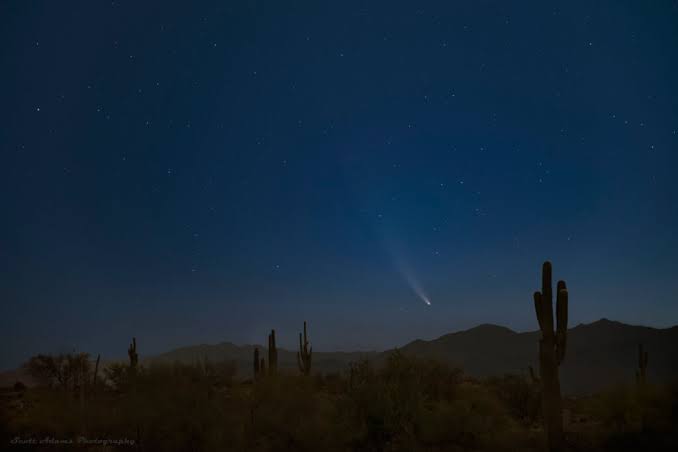
There is a moment, somewhere between the last glow of a desert sunset and the first appearance of a truly unclouded night sky, when Scottsdale reveals something most visitors never expect: absolute, jaw-dropping darkness above, and a universe that feels close enough to touch. That is the moment Evening Star Tours has built its entire reputation around, and once you experience it, you will understand why people fly in from across the country just to spend a few hours standing in the Sonoran Desert, necks craned skyward.
Evening Star Tours operates out of the McDowell Mountain Regional Park corridor on Scottsdale’s northeastern edge, well beyond the amber wash of downtown resort lights. The guides — genuine astronomy enthusiasts with a gift for making astrophysics feel like good conversation — load up a van and escort small groups out to carefully scouted dark-sky sites where the Milky Way doesn’t just appear; it pours across the horizon in a thick, luminous band that honestly stops your breath the first time you see it.
What sets this experience apart from simply driving out to the desert and looking up is the equipment and the storytelling. The tour uses high-powered Dobsonian telescopes, the kind that resolve the rings of Saturn so sharply that first-timers often laugh out loud in disbelief. One minute you are identifying Orion’s Belt with the naked eye, and the next you are peering at the Orion Nebula — a stellar nursery roughly 1,344 light-years away — rendered in smoky, luminous detail. Your guide narrates the whole thing with the easy confidence of someone who genuinely loves this material, weaving in mythology, physics, and just enough Arizona history to keep the experience grounded in place.
Tours typically run between two and three hours, beginning around dusk to catch the golden hour over the saguaros and wrapping up well into the evening. Group sizes are intentionally small — usually capped at eight to twelve guests — which means you actually get time at the eyepiece and real answers to your questions, not a rushed shuffle past a telescope while someone waves you along. Dress in layers; desert nights cool off quickly even in late spring, and the experience is considerably more pleasant when you are not shivering through it.
This is the kind of outing that works beautifully for couples celebrating something special, for families with curious kids who have outgrown the zoo, and for solo travelers who want to feel genuinely connected to a place rather than just passing through it. Scottsdale’s resort scene is polished and wonderful, but there is something profoundly different about standing under ten thousand visible stars in the middle of the Sonoran Desert with a knowledgeable guide pointing out galaxies by name.
Reservations are available through the Evening Star Tours website, and booking ahead is strongly recommended — these tours sell out regularly, particularly during fall and winter when the skies are at their clearest and the temperatures are at their most forgiving. Plan to arrive a few minutes early, leave your phone flashlight off once you are on-site (red lights only, to protect night vision), and prepare to spend the drive back into town recalibrating your sense of scale. The universe is very large. Scottsdale’s slice of it is extraordinary.